Uncovering the Unseen: Why Ghost Hunting Fascinates Us and How to Use That Curiosity Creatively
Ghost hunting has a strange way of pulling people in. Even when someone does not fully believe in spirits, haunted houses, unexplained noises, and eerie recordings can still feel impossible to ignore. Part of that comes from the fact that the paranormal sits right at the intersection of fear, uncertainty, memory, and imagination. We are wired to notice the unusual, search for patterns, and pay attention when something feels emotionally charged. That is why ghost stories keep working on us, generation after generation.
And the fascination is not just personal. It is cultural too. According to Pew Research Center, about 65% of U.S. adults say they believe in spirits or unseen spiritual forces, and Gallup reported in 2025 that about 39% of Americans believe in ghosts. Those numbers help explain why paranormal stories remain so persistent in public life, from campfire legends to viral videos to full-scale ghost tours. Source: https://www.pewresearch.org/religion/2023/12/07/spiritual-beliefs/ and https://news.gallup.com/poll/692738/paranormal-phenomena-met-skepticism.aspx
Why the Paranormal Pulls Us In
The paranormal is compelling because it promises contact with something just beyond the edge of ordinary explanation. That small gap between what we can explain and what we cannot is where curiosity lives. A creaking floorboard in an empty hallway is usually only a building settling, but it can also become a story about presence, memory, or warning. Our minds are constantly trying to resolve that uncertainty, and when the answer is not obvious, attention intensifies.
Ghost stories also invite us to participate. Unlike many forms of entertainment, they ask us to interpret the experience ourselves. Was that a voice, or a draft? A shadow, or a trick of light? That uncertainty makes haunted stories feel active rather than passive. They are less like facts handed down to us and more like puzzles we keep trying to solve.
That is one reason paranormal curiosity survives skepticism. You do not have to believe in ghosts to enjoy the feeling that something might be there. In fact, a skeptical mind can make the experience even more interesting because it keeps toggling between explanation and possibility.
The Brain on Fear, Mystery, and Pattern Recognition
Fear is not only unpleasant. In small doses, it can be exhilarating. When we feel fear in a safe context, such as a haunted house, ghost story, or paranormal investigation, the body responds with heightened arousal, sharper attention, and stronger emotional encoding. In other words, the brain pays more attention to what feels threatening or mysterious because, from an evolutionary perspective, that could matter for survival.
Pattern recognition plays a huge role here too. Humans are meaning-making machines, and we are particularly sensitive to fragments that resemble faces, voices, footsteps, or intention. When a situation is ambiguous, the brain often fills in the gaps. That can be useful in daily life, but it can also lead us to see agency in randomness. Research on paranormal belief and conspiracy thinking has shown that both are predicted by a tendency toward illusory pattern perception, or seeing meaningful patterns where none may exist. Source: https://pmc.ncbi.nlm.nih.gov/articles/PMC5900972/
Sensory sensitivity can deepen this effect. Williams and Blagrove found that people with higher sensory-processing sensitivity were more likely to report anomalous experiences and more likely to detect meaning in degraded or ambiguous stimuli, such as hearing voices in noise. Source: https://pmc.ncbi.nlm.nih.gov/articles/PMC9473424/
That means ghost hunting is never only about the location. It is also about the perceiver. Two people can stand in the same room, hear the same sound, and walk away with two entirely different stories about what happened.
Why Creepiness Feels So Addictive
Creepiness is a special kind of discomfort because it does not fully resolve into fear. It is the feeling that something is off, but not yet explained. That kind of liminal uncertainty is highly engaging. We keep scanning, listening, and wondering because the brain dislikes unresolved signals. It wants closure, but it also wants to know what lies behind the curtain.
This is why haunted spaces are so memorable. The most powerful moments are often not dramatic apparitions, but tiny disturbances: a door moving by itself, a whisper on a recording, a feeling of being watched in an otherwise ordinary room. These almost-events are enough to spark a story, and once a story starts, the mind keeps returning to it, comparing details, replaying sensations, and adding emotional weight.
In that sense, creepiness can become a form of suspense. It is not just fear of danger. It is anticipation, ambiguity, and the thrill of not knowing yet.
How Folklore and Media Teach Us What to Fear
What we expect to see in a haunted place is not random. Folk traditions, local legends, horror films, and paranormal television all teach us the script. They shape what counts as a ghostly sign and what feels like evidence. A cold spot, a child’s laughter, a door slamming in an old house, these details have been culturally rehearsed so many times that they can become almost automatic cues for the supernatural.
Media matters because it does not just reflect belief. It can strengthen it. A 2023 study found that horror media claiming to be based on real events, such as paranormal reality TV or based-on-true-events content, was linked to stronger belief in the paranormal, while purely fictional horror had less impact on belief. Source: https://www.psypost.org/spooky-screen-time-new-study-links-specific-horror-media-with-belief-in-the-paranormal/
That pattern also shows up in day-to-day viewing habits. A 2024 survey of 1,035 U.S. adults found that watching paranormal documentary or reality television, using paranormal news, and consuming YouTube haunting content all predicted belief in hauntings, even after controlling for other factors. Source: https://journals.sagepub.com/doi/abs/10.1089/cyber.2023.0667?download=true
So when people arrive at a supposedly haunted location, they rarely arrive empty-handed. They bring scripts, visuals, and expectations built by culture. The experience becomes a collaboration between place and imagination.
Why Haunted Stories Go Viral Online
Online, ghost stories spread because they are perfect social content. They are brief, emotionally charged, difficult to verify, and easy to comment on. They invite debate without demanding resolution. One person sees proof, another sees coincidence, and both keep the conversation alive.
Digital platforms also reward the dramatic and the uncanny. A short clip of a shadow moving in a hallway or a strange sound on an EVP recording is more likely to be shared if it creates instant unease. The internet turns personal mystery into collective participation. Viewers do not just consume the story, they investigate it, react to it, and often remix it into new forms.
That social feedback loop matters. When a paranormal clip goes viral, it does not simply entertain people. It can also reinforce the idea that the unexplained is common, accessible, and worth chasing. This is one reason ghost hunting has become both a hobby and a content genre.
Ghost Hunting as Experience, Performance, and Meaning-Making
Modern ghost hunting is not only about proving whether a spirit exists. For many people, it is also about experience, performance, and meaning-making. The process itself has value: gathering at night, exploring forgotten places, listening closely, and sharing stories afterward. It can feel ritualistic, even when participants remain skeptical.
That matters because people often use paranormal encounters to organize emotional experiences that are hard to name otherwise. Grief, nostalgia, fear, and awe can all gather around a haunted story. A location may become meaningful not because it objectively contains a ghost, but because it becomes a container for memory and feeling.
In that sense, ghost hunting is often less about hunting than about noticing. It is a practice of paying attention to the overlooked, the hidden, and the unresolved. And that can be valuable whether or not you ever capture definitive proof.
Creative Ways to Explore Paranormal Curiosity Safely
If you are drawn to the paranormal, you do not have to limit yourself to chasing evidence. Curiosity can be redirected into reflection, storytelling, research, and art. That is often a healthier and more rewarding way to engage with weird experiences than trying to force certainty out of them.
A good starting point is to treat unusual moments like material for exploration rather than immediate conclusions. Ask what happened, what you felt, what else could explain it, and why it stuck with you. That approach keeps the experience open without dismissing it.
Safety matters too. If you are visiting a location, do it legally and respectfully. If you are exploring a scary experience at home, make sure you are not overlooking practical causes like wiring, sound, temperature, stress, or sleep disruption. Creative curiosity works best when it is grounded in care.
Journaling, Research, and Story Sharing Instead of Just Chasing Proof
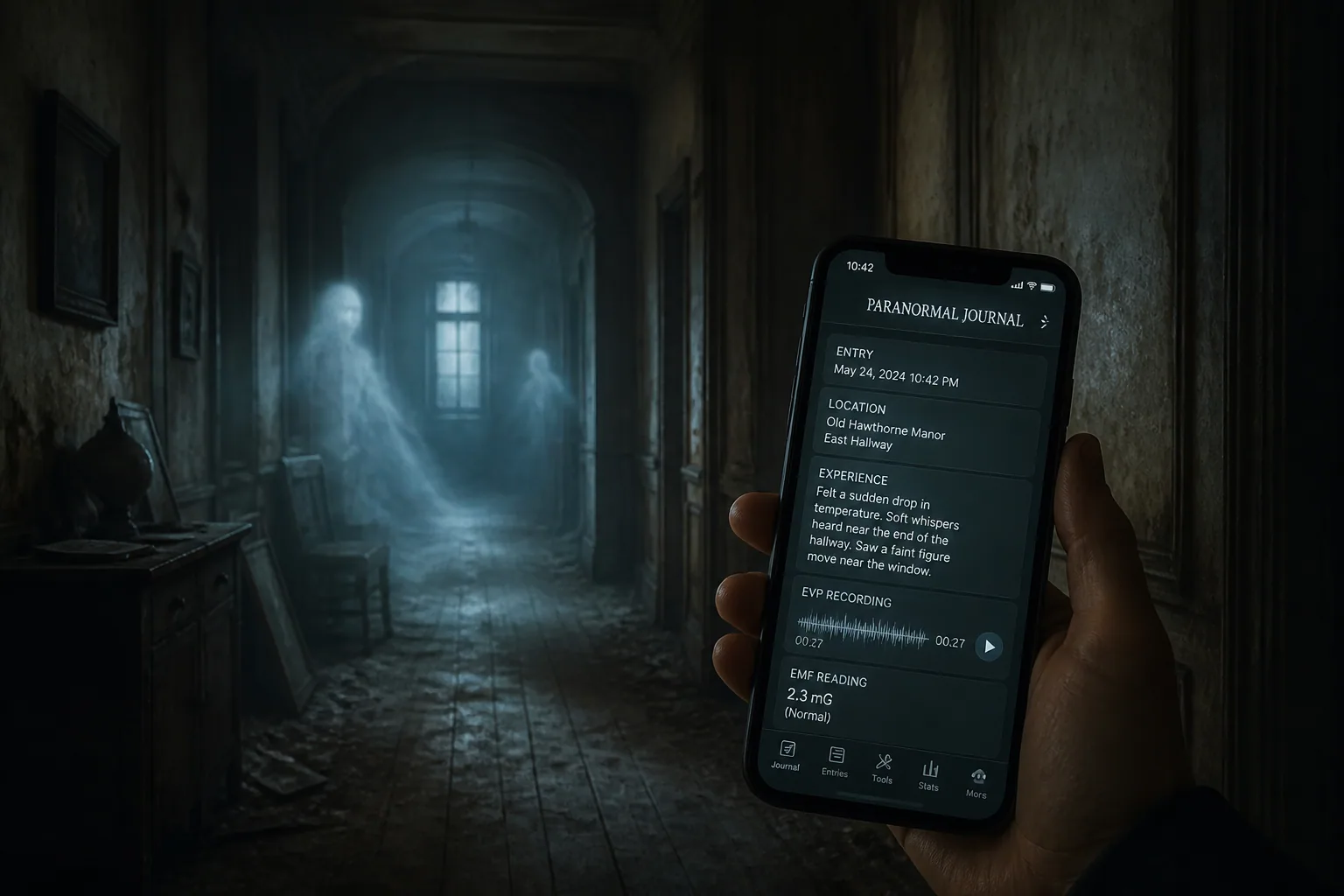
One of the most useful ways to work with paranormal curiosity is journaling. Write down what happened, where it happened, who was present, and how you felt before and after. Over time, this can reveal patterns in your own perception, mood, and environment. It also gives you a record that is more nuanced than a quick social post.
Research can deepen the experience too. Learning about regional ghost lore, local history, burial practices, old buildings, and folklore traditions can transform a vague spooky feeling into a richer understanding of why a place is associated with hauntings in the first place. Often the story behind a ghost is just as interesting as the ghost itself.
Sharing stories with others is another powerful step. When people compare experiences, they often discover how much suggestion, expectation, and memory shape what they remember. Research on suggestion and social influence shows how easily memory can be altered. In the study “Magic and Memory,” participants who were told a paranormal event continued rather than ended were more likely to remember that it continued, especially if they already believed in paranormal phenomena. Source: https://pubmed.ncbi.nlm.nih.gov/25431565/
That does not mean people are lying. It means human memory is collaborative and impressionable. Talking things through can help you see both the emotional truth and the uncertain details more clearly.
How Tools Like Ectify Help Document and Process the Unexplained
If you enjoy documenting strange moments, a dedicated app can make the process more organized and more creative. Ghost Detector: Ectify turns your smartphone into a ghost hunting tool for recording, reviewing, and sharing sessions. You can explore it here: https://findthe.app/ectify-fc72z0
What makes a tool like Ectify useful is not that it proves anything supernatural on its own. Rather, it helps you structure the experience. Real-time EMF detection, session recording, EVP-style interaction, and session history create a more complete archive of what you observed and when. That can be helpful for anyone who wants to revisit a location, compare sessions, or reflect on recurring patterns without relying on memory alone.
It can also support the creative side of ghost hunting. A recorded session can become a video, a storytelling project, a social media post, or simply a personal log of an unusual night. For people who enjoy the atmosphere of investigations, that kind of documentation can turn a fleeting experience into a lasting project.
Used thoughtfully, tools like this sit at the intersection of play, curiosity, and self-reflection.
Turning Fear and Fascination Into Art, Reflection, or Community
The deepest value of paranormal curiosity may be what it produces afterward. Fear can become a short story, a poem, a painting, a video essay, or a conversation that helps someone feel less alone. Even an unresolved experience can become meaningful when it is transformed into something shareable.
Art is especially good at holding ambiguity. It does not need to decide whether a strange event was truly supernatural. It can preserve the emotional texture of the moment, the unease, the wonder, the doubt, and the memory of being changed by it. That is often more honest than trying to force a neat explanation.
Community matters too. Haunted stories often function like modern folklore. They are passed along, adapted, and reinterpreted. When people tell and retell them, they are not only describing the unknown. They are building a shared language for awe, grief, curiosity, and fear.
So whether you are a believer, a skeptic, or somewhere in between, ghost hunting can be more than a search for proof. It can be a way of paying attention to how the brain works, how culture shapes perception, and how strange experiences become stories. And if you approach that curiosity creatively, it can lead to something lasting: insight, art, connection, or simply a better understanding of why the unseen continues to fascinate us.
