Unexpected Natural Phenomena vs Paranormal: Everyday Science That Fools Ghost Hunters
Not every eerie sound, strange light, or sudden chill points to a ghost. In fact, a lot of the most convincing paranormal moments can be explained by ordinary environmental factors that are easy to overlook in the dark, under stress, or in a place full of expectation. For beginner ghost hunters and healthy skeptics, this is actually good news: the more you understand natural phenomena, the better your evidence gets.
This is where a lot of investigations go off the rails. A room feels heavy, an EMF meter jumps, someone gets dizzy, and the conclusion becomes immediate. But weather, geology, wiring, building materials, altitude, and even your own nervous system can all shape what you see and feel. If you learn how those pieces fit together, you can reduce false positives and decide more carefully when something is genuinely hard to explain.
Why ‘Paranormal’ Isn’t Always Paranormal
Ghost hunting often begins with a simple assumption: something unusual happened, so something supernatural must be responsible. The problem is that unusual does not automatically mean unexplained. A lot of locations have conditions that are just strange enough to look intentional. A draft can move a curtain. A loose wire can create an EMF spike. A pressure change can make you feel uneasy without any visible cause.
Research also shows that expectation matters a great deal. In the “Haunt Project,” participants were more likely to report odd sensations when they believed a place was haunted, even when the environmental factors did not neatly account for every report. That does not mean the experiences were fake. It means human perception is highly sensitive to context, suggestion, and ambiguity. Source: https://www.sciencedirect.com/science/article/pii/S0010945208001299
That is why a good investigator stays curious before becoming convinced. The goal is not to dismiss everything. It is to separate environmental causes, human error, and the smaller category of events that still resist easy explanation.
The Most Common Natural Phenomena That Mimic Hauntings
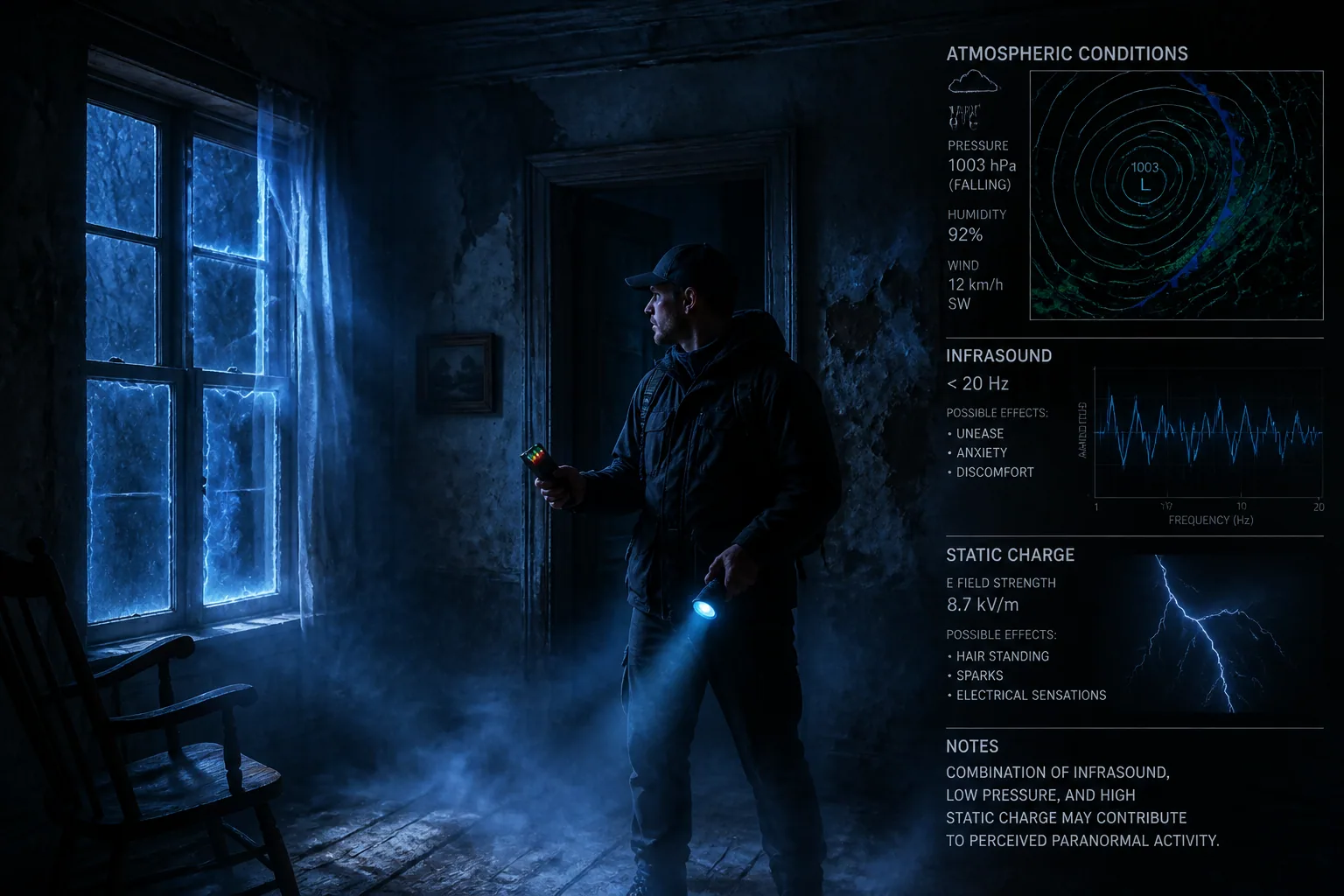
A surprising number of haunting reports can be traced to a short list of environmental factors. Infrasound can create fear and physical discomfort. Ionized air can create eerie glows. Earth tides and geology can subtly affect a location. Electrical problems can trigger sensations and false readings. Weather and altitude can alter mood, balance, and visual perception.
What makes these so effective at fooling ghost hunters is that they often show up as feelings before they show up as evidence. People notice a presence, a cold spot, a pressure in the chest, a buzzing in the ear, or a light that seems too blue to be normal. By the time the meter is checked, the story already feels supernatural.
The trick is to remember that haunting-like experiences do not need a haunting-like cause. Natural conditions can produce surprisingly theatrical results, especially in old buildings, poor weather, low light, or places with strong emotional expectations.
Infrasound: The Sound You Feel More Than Hear
Infrasound refers to sound waves below about 20 Hz, low enough that people may not consciously hear them but can still feel them. That matters because the body can react to these frequencies even when the room seems silent. A recent lab study summarized by Ars Technica reported that exposure to infrasound was linked with elevated salivary cortisol, increased irritability, negative affect, fatigue, and sensations like being watched or touched, even when the sound itself was imperceptible. Source: https://arstechnica.com/science/2026/04/that-spooky-sensation-likely-due-to-rumbling-pipes-not-spirits/
The practical ghost-hunting problem is obvious. If a basement pipe, ventilation system, nearby machinery, or even certain architectural resonances create persistent low-frequency vibration, people may start describing the room as oppressive or inhabited. Because the effect is subtle, the body can interpret it before the mind has a clear reason.
This is one reason investigators sometimes report nausea, anxiety, or a feeling of dread in a room that turns out to have no obvious visual problem. Infrasound does not need to be loud to be influential. It just needs to be present, repetitive, and hard for the conscious mind to identify.
St. Elmo’s Fire, Ionized Air, and Strange Glows
Some of the most haunting-looking lights in the natural world are actually electrical in origin. St. Elmo’s Fire is a plasma phenomenon that appears when strong electric fields ionize the air around pointed conductors, producing a blue-violet glow and sometimes a hissing or buzzing sound. It often happens during thunderstorms or other high-voltage atmospheric conditions, especially near metal tips, masts, or sharp edges. Sources: https://www.livescience.com/st-elmos-fire.html and https://www.weather.gov.hk/en/education/aviation-and-marine/aviation/00534-st-elmos-fire-as-seen-from-aircraft.html
For ghost hunters, this matters because ionized-air glow can look like a floating light, a brief orb, or a supernatural flicker. In the right conditions, other corona discharges and electric-blue glows can be mistaken for paranormal phenomena as well. If you are already in a dramatic place, at night, near old metal infrastructure, or during unsettled weather, the effect can feel like a textbook ghost sign.
The broader lesson is that light is not always simple. It can be shaped by electric fields, humidity, airborne particles, and the geometry of the object producing it. A glow near a fence, tower, antenna, or roofline may be a physics event first and a mystery second.
Earth Tides, Geology, and Buildings That Shift and Creak
Earth is not perfectly still. Earth tides are the elastic deformation of the planet’s crust caused by the gravitational pull of the Moon and Sun. These shifts are tiny, but they are real and measurable. USGS research has shown earth-tide effects in groundwater fluctuations in wells in places like New Mexico and Iowa, demonstrating that gravity-driven changes happen continuously even far from the ocean. Source: https://pubs.usgs.gov/publication/70214133
Why does that matter in a haunted building? Because tiny geophysical changes can affect water, pressure, and stress in the ground and structure. Over time, those shifts can contribute to creaks, pops, settling sounds, and small changes in how a location feels. In an old house or historic site, those sounds may be interpreted as footsteps, knocks, or movement in the walls.
Geology also matters. Locations built over magnetic minerals, old tunnels, voids, underground water, or unstable soil can produce unusual conditions that interact with equipment and perception. What feels like a spirit passing through a room may simply be the environment flexing in ways most people never notice in daily life.
How Weather, Wiring, and Building Materials Skew Investigations
Weather can change an investigation fast. Humidity affects how air feels. Storms change electrical fields. Temperature drops can create condensation, drafts, and visible breath. Barometric shifts can make people feel headachy or uneasy, and wind can create knocking, rattling, or pressure effects that sound surprisingly deliberate.
Building materials matter too. Older buildings often contain a mix of metal, aging insulation, plaster, wood, pipes, and patchwork repairs. That combination can create hotspots for static, interference, or vibration. Poor grounding, nearby power lines, and unshielded wiring can raise EMF levels and produce odd detector readings. In the study by Persinger, Koren, and others, houses with electronic irregularities and transient fields in the range of roughly 1 to 5 microteslas at 50/60 Hz sources were associated with more haunt-type experiences. Source: https://journals.sagepub.com/doi/10.2466/pms.2001.92.3.673
This does not prove that EMF causes ghosts. It does show that the environment can be a powerful trigger for sensations people describe as paranormal. A buzzing meter, a headache, a metallic smell, or a sudden drop in confidence may all have mundane causes tied to the structure itself.
That is also why location context is so important. A site near a transformer, radio equipment, old electrical infrastructure, or geological anomalies deserves much more skepticism than a quiet room with no identifiable sources.
What You Can Notice Without Tools in the Field
You do not need a full kit to start thinking scientifically. Some of the most useful observations are the simplest ones. Pay attention to whether sensations happen in one exact spot or across the whole building. Notice whether a feeling comes and goes with wind, weather, or nearby traffic. Track whether multiple people feel the same thing at the same time, or whether only one person does.
Also watch for patterns in your own body. If you start feeling lightheaded, irritated, or watched in one corner of a room, ask what else is happening. Is there a hum? A draft? A stairwell? An exposed wire? A metal structure outside? Is the sensation stronger after someone says the place is haunted? Those questions matter more than people think.
One of the best field skills is simple comparison. Walk away from the hotspot, then return. Change your angle. Turn off unnecessary devices. Wait a few minutes. Natural effects often behave consistently with the environment, while many paranormal claims become less convincing when tested against time, distance, and repetition.
Best Beginner Tools for Spotting Environmental False Positives
A beginner does not need a room full of gadgets, but a few basics help separate atmosphere from anomaly. A flashlight, temperature reading, and phone audio can go a long way. An EMF meter is useful too, as long as you remember it is a context tool, not proof of anything by itself.
It can also help to record a brief baseline at the start of every session. Note the room temperature, weather, nearby electronics, and any obvious sources of noise or light. If a reading changes, ask what changed in the environment first. That habit alone eliminates a lot of false positives.
If you want a more immersive way to document sessions, a smartphone-based app like Ghost Detector: Ectify can be a convenient companion, especially because it records activity and keeps session history in one place. Used carefully, it is most helpful when you treat the data as a starting point for questions, not as automatic proof. Product link: https://findthe.app/ectify-fc72z0
A Practical Checklist for Ruling Out Natural Causes
Before you label an event paranormal, walk through a basic checklist. First, identify the location. Is there nearby wiring, a transformer, plumbing, vents, metal framing, or a storm in progress? Second, identify the sensation. Is it a sound, a light, a smell, movement, or a bodily feeling? Third, identify repeatability. Can the event be recreated, or does it happen only under certain conditions?
Next, compare witnesses. If multiple people describe the same thing independently, that is more interesting than a single report. But even then, ask whether they were standing in the same draft, hearing the same low-frequency vibration, or primed by the same story. Shared context can produce shared interpretation.
Finally, document what was ruled out. Many investigations fail because the only notes are about what seemed strange. A stronger report includes what was checked and excluded. That turns a spooky story into useful evidence.
Decision Tree: Natural Event, Human Error, or Something Unexplained?
A simple decision tree can keep your conclusions grounded. Start with the easiest question: is there a known environmental source nearby? If yes, investigate that first. If the answer is no, ask whether the event could be caused by equipment behavior, observer expectation, or setup error. Loose batteries, auto settings, interference, and poor calibration account for more “anomalies” than many teams like to admit.
If the event still holds up after environmental and human factors are checked, move to the harder question: does it repeat under similar conditions? A one-time event is interesting, but not strong evidence. A repeated pattern in the same place, with the same controls, is more meaningful.
And if the answer is still unclear, that is okay. Unexplained is not the same as paranormal. It just means you have not yet found a better explanation. Good investigators are comfortable with that distinction.
Safer Ghost Hunting Through Better Environmental Awareness
Environmental awareness makes investigations safer as well as smarter. Storms, unstable structures, exposed wiring, poor air quality, and extreme altitude can all create real physical risk. If a location is making people dizzy, anxious, or disoriented, do not ignore it just because you are expecting a haunting. Those symptoms may be a clue that the site is unsafe.
It is also wise to keep sessions short enough to preserve judgment. Fatigue and expectation can amplify every creak and shadow. The more tired the team, the easier it becomes to over-interpret ordinary events. Taking breaks, comparing notes, and checking conditions outside the building can prevent a lot of bad conclusions.
In other words, safer ghost hunting is not less interesting. It is more disciplined. It helps you separate the environment from the experience, which makes the final story more credible whether you find a natural explanation or not.
When a Strange Experience Still Deserves a Second Look
Even after you account for infrasound, ionized air, earth tides, wiring, weather, and expectation, some experiences will remain odd. That does not automatically make them supernatural, but it does mean they are worth recording carefully. Rare events often become useful only when they are documented well enough to be compared later.
A second look is especially worthwhile when several factors line up at once. If the location has unusual geology, historical electrical issues, strong emotional context, and multiple independent witnesses, you may be dealing with something that is not easy to reduce to a single cause. That is where patience matters most.
Healthy skepticism is not about shutting the door on the unexplained. It is about making sure the door is not already open because of the wind.
