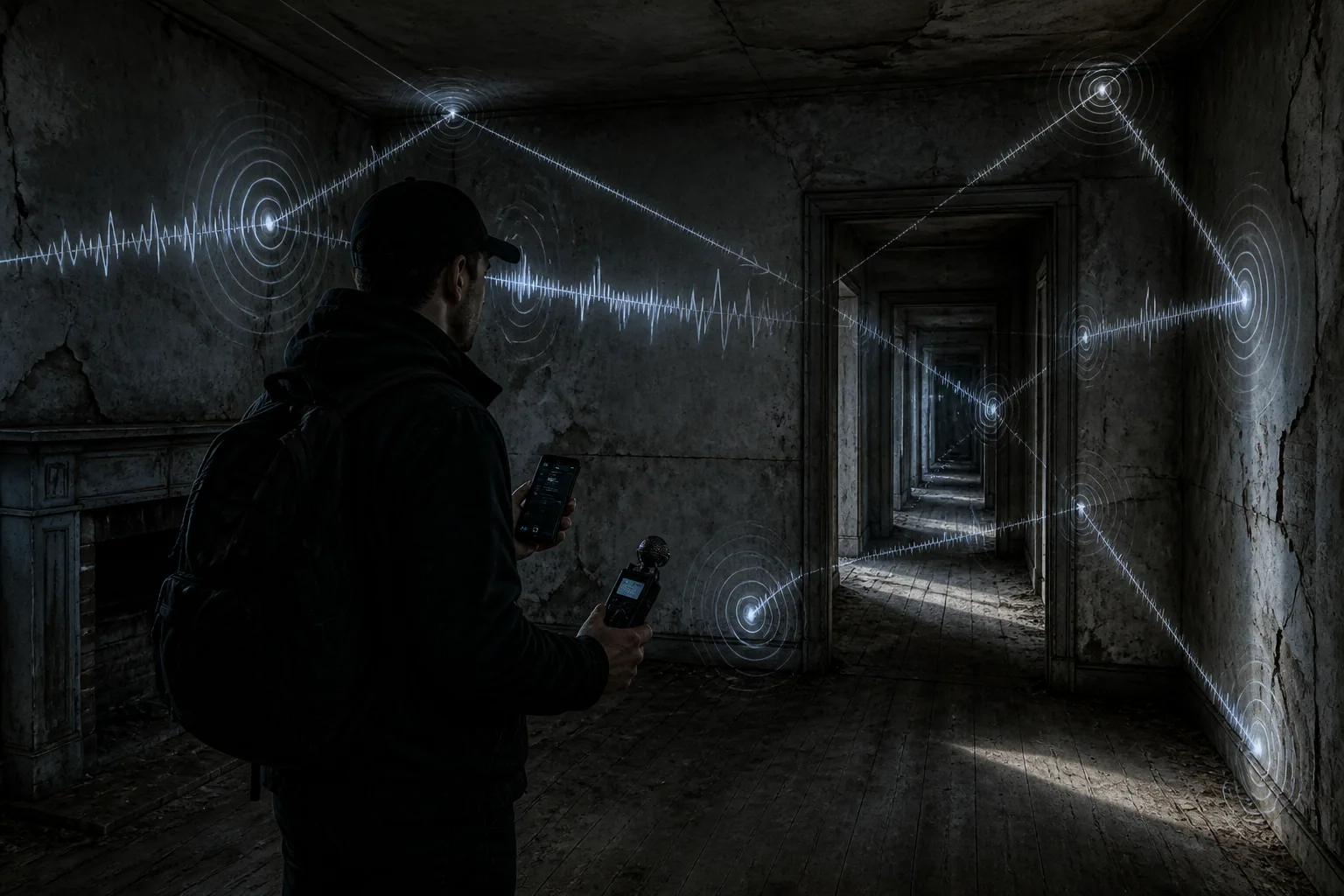
Unseen Voices: How to Capture Room Resonances, Sound Reflections and Acoustic Feedback in Ghost Hunts
If you have ever listened back to a ghost hunt and wondered whether that whisper, scrape, or strange reply was paranormal or just the room itself talking back, you are asking the right question. Acoustics shape every investigation. A basement, stairwell, hallway, or crawl space does not just hold sound, it changes it. It bends it, stretches it, reflects it, and sometimes disguises it so well that a normal echo can feel like a voice.
That is why better ghost hunting is not only about equipment and timing. It is also about understanding how a space behaves. Once you learn how room resonance, sound reflection, and acoustic feedback work, you can record cleaner evidence, reduce false positives, and avoid mistaking environmental audio artifacts for something unexplained.
Why Acoustics Matter in Ghost Hunts
In paranormal investigations, the room is part of the instrument. Every wall, floor, ceiling, doorway, staircase, and surface shapes what your microphone hears. Even a simple voice can become harder to interpret when the space creates reverberation, standing waves, or delayed reflections.
This matters because many ghost hunting tools are highly sensitive to sound. Spirit boxes, EVP recordings, and phone microphones can all pick up fragments of your own speech, other team members, HVAC noise, or echoes bouncing around the room. If the space is reflective, the result can sound eerie even when nothing unusual happened. Historical research on auditory illusions has shown that echoes, whisper-like reflections, and interference patterns have often been interpreted as supernatural, even when they are explainable by acoustics https://acoustics.org/auditory-illusions-of-supernatural-spirits-archaeological-evidence-and-experimental-results-steven-j-waller/
The key idea is simple. If you know how a room behaves, you can hear with more confidence. And if you know where sound is likely to mislead you, you can place your gear more intelligently and interpret your evidence more carefully.
What Room Resonance Is and Why Spaces Have Their Own Voice
Room resonance happens when a space naturally reinforces certain frequencies. These are often called room modes or standing waves. In practice, that means some tones become louder in specific parts of the room, while others seem weaker or disappear. This is why a basement corner can sound very different from the center of the room, even when you are speaking at the same volume.
The shape of the room, its dimensions, and the materials inside it all matter. A narrow hallway, for example, can emphasize a very specific band of frequencies, while a square room may create more obvious buildup at certain notes. That can make a whisper sound oddly tonal or give a simple footstep a hollow character. Room acoustics research also shows that reverberation time depends on volume, surface area, and absorption. The Sabine formula expresses this relationship as T = 0.16·V/(S×α), which means larger spaces with more reflective surfaces generally produce longer decay times https://speech.kth.se/music/acviguit4/part3.pdf
This is one reason old buildings feel so different from ordinary homes. A big, mostly hard-surfaced room does not just sound louder. It can seem to have a voice of its own. When ghost hunters hear a strange repeat or tonal shift, that room resonance may be the reason.
Researchers studying room acoustics have found that even average reverberation times vary significantly by space. Furnished living rooms around 44 m³ showed reverberation times falling from about 0.69 seconds at 125 Hz to about 0.40 seconds at 8 kHz, while kitchens around 23 m³ still had longer low-frequency decay, near 0.76 seconds at 125 Hz, before dropping across higher bands https://www.sciencedirect.com/science/article/pii/0003682X72900308 That means low sounds often linger longer than speech-like sounds, which can distort what a recorder captures.
How Large Halls, Small Rooms and Crawl Spaces Change Recorded Sound
Different spaces create very different acoustic impressions. Large halls and auditoriums usually allow sound to travel and persist longer, while smaller rooms can feel more immediate and cramped. Clinical room measurements show the same pattern clearly. RT20 values averaged about 0.18 seconds in small rooms, about 0.22 seconds in mid-size rooms, and about 0.48 seconds in large rooms for speech-frequency bands https://pmc.ncbi.nlm.nih.gov/articles/PMC6375510/
In a large hall, your voice can return to you after enough delay that it sounds like another presence. In a small bedroom, reflections arrive so quickly that they can blur together and create a boxy, confined tone. In a crawl space, the effect can become even more unsettling because the space is tight, irregular, and often full of hard boundaries that trap and bounce sound in strange ways.
The practical takeaway is that a location can make ordinary sounds seem active. A slow-decaying hall can turn a soft remark into a lingering phrase. A cramped utility room can make breath, clothing movement, and foot shuffles sound like someone else is nearby. If you are recording in spaces like stairs, basements, or crawl spaces, expect the room to alter your evidence before you ever press record.
Acoustic guidance for speech spaces usually recommends mid-frequency RT60 values between about 0.4 and 0.8 seconds, while music-oriented spaces and large auditoriums may run closer to 1.0 to 2.0 seconds or more https://www.nti-audio.com/en/applications/room-building-acoustics/reverberation-time That range gives you a useful frame for ghost hunts. If a location feels especially live, your recorder may be capturing more room than event.
Sound Reflection: How Walls, Floors and Ceilings Create False Clues
Sound reflection is the bounce. A direct sound leaves a source, hits a surface, and returns to your ears or microphone. In a room with concrete, brick, tile, glass, or bare drywall, those reflections can be strong enough to create obvious echoes or subtle enough to simply change the tone of what you hear. Highly reflective surfaces increase reverberation and can make speech less intelligible, while absorptive materials like carpet, drapes, acoustic panels, and ceiling tiles reduce those effects https://support.nureva.com/docs/acoustic-check-reverberation-measurement
This is where many false clues begin. A reflected footstep can sound like movement behind you. A delayed bit of your own speech can resemble a response. A door closing in one room can arrive as a dull thud in another, confusing the source direction. When reflections overlap, they can produce whisper-like artifacts or make an ordinary sound seem layered and intentional.
The floor matters just as much as the walls. Tile, wood, and concrete tend to reflect quickly and strongly. Thick carpet and rugs absorb more energy, especially at higher frequencies. Ceilings matter too. A low hard ceiling can create flutter echo, which is that rapid ping-pong effect that makes a room sound sharp and artificial. If you are in a stairwell, each landing and wall surface can turn into a reflector, causing sounds to ping down the shaft in ways that feel almost directional but are actually environmental.
One useful acoustics concept here is critical distance. It is the point where direct sound and reverberant sound are equal. Beyond that distance, reflections dominate what the listener or microphone receives. In a highly live room, the critical distance shrinks, so even a recorder placed only a few feet away can capture more room than source. That makes placement a major part of evidence quality.
When Reverb Mimics EVP and Other Paranormal Audio
Reverberation is one of the biggest reasons EVP-style clips can be misleading. When a word or syllable is reflected around a room, its tail can smear into the next sound. On playback, that can turn into something that seems like a voice. If there is background noise, a fan, or team members moving through the space, the reflected pattern can become even harder to parse.
This is especially true in spaces with strong echoes or repeated reflections. A short statement such as “Did you hear that?” may come back as fragments that sound like “hear that” or “that.” A recorder can preserve the original phrase, the reflected tail, and the room tone all at once. Your brain then tries to interpret the pattern, and in a haunted setting it is easy to overread it.
This is also why many investigators should treat every strange audio result as a room question first. Was there a reflective wall behind the microphone? Was the recorder placed near a corner, doorway, or duct? Was someone speaking off-axis? Did the sound come from your own team and bounce back after a delay? These are not skeptical distractions. They are the most likely explanations to rule out before any paranormal interpretation.
A practical mindset helps here. If the clip only sounds mysterious in one playback app, or only when boosted with equalization, the room may be doing the work. If the same syllables appear in different places because of repeated reflections, then you are probably hearing acoustics rather than a voice from beyond.
Understanding Acoustic Feedback in Spirit Boxes and Recording Setups
Acoustic feedback happens when a microphone captures sound from a speaker and sends it back through the system in a loop. It is the classic squeal, howl, or unstable tone that can show up when a mic and speaker are too close together. In ghost hunting, that matters because spirit boxes, loud playback devices, and even phone-based setups can create artifacts that sound dramatic but are purely technical.
Feedback is not the same as echo, but the two can work together. A reflective room increases the chance that sound will keep bouncing toward the microphone. If your speaker is playing rapidly changing audio and the mic is open nearby, the space can reinforce part of the output and create odd bursts, tones, or overlapping fragments. That is exactly the kind of sound that may be mistaken for an intelligent response.
Some newer acoustic models can estimate room shape and reflector positions using direct-to-reverberant energy ratio, even in noisy conditions where the signal-to-diffuse ratio drops to around -10 dB https://www.sciencedirect.com/science/article/pii/S0003682X24003670 For investigators, that is a reminder that rooms leave measurable fingerprints. What seems like a mysterious response may actually be the acoustics of the room being captured and reproduced by the gear.
To reduce feedback risk, keep microphones separated from speakers, avoid pointing devices directly at reflective surfaces, and do not assume a strong burst in a spirit box is evidence on its own. First ask whether the setup itself could have created the sound.
How to Test a Room’s Acoustic Profile Using Only Your Phone
You do not need studio gear to understand a room. Your phone can give you a surprisingly useful first look at how a space behaves. The goal is not precision measurement. It is practical awareness. If you can identify whether the room is live, dead, reflective, or uneven, you can improve your investigation before the actual session begins.
Start by standing in the middle of the room and speaking a few short lines at a normal volume. Then repeat them near corners, doorways, and hard walls. Listen for changes in brightness, delay, and loudness. A phone voice memo can help you compare how each position sounds. If the room is highly reflective, you will hear the environment more than the voice.
You can also move through the room and record short samples while facing different directions. This helps you notice whether certain spots emphasize bass, treble, or room echo. If a corner or stair landing sounds much louder than the center of the room, you are likely dealing with strong reflections or a resonant zone.
The point is to map the room before you start chasing anomalies. Once you know where the space blooms, rings, or deadens sound, you will understand your audio evidence more clearly later.
Simple Echo Timing, Clap Tests and Voice Sweep Techniques
The clap test is one of the easiest ways to judge room acoustics. Clap once, then listen to how quickly the sound dies out and whether you hear a clean decay or a fluttering series of repeats. A short, clean decay suggests more absorption. A bright, lingering clap suggests more reflection. If the clap turns into a metallic rattle, the room is likely producing flutter echo between parallel surfaces.
Echo timing can be just as helpful. Say a single word, such as “hello,” and count how long it takes for the last audible reflection to disappear. You do not need a stopwatch for a rough evaluation. You are simply trying to compare areas. A hallway may hold the sound much longer than a carpeted living room. A tile bathroom may snap back with a sharp early reflection, while a furnished bedroom may absorb more than you expect.
Voice sweeps are another easy method. Speak slowly from low to high pitch, then repeat the sweep from different positions in the room. Certain notes may jump out because of room modes, while others may vanish. If the same pitch suddenly grows louder near a wall or in a corner, that is a sign the room is resonating at that frequency. For ghost hunts, that means your own voice or a spirit box scan could be distorted in that area, making interpretation harder.
If you want a simple rule, use this one. The more the room changes your clap or voice, the more cautious you should be when labeling a sound as paranormal.
How to Identify Hard vs Soft Surfaces Before You Record
Before you set up for a session, walk the space and look for what the room is made of. Hard surfaces reflect sound. Soft surfaces absorb it. That distinction sounds obvious, but in practice it is easy to overlook the mix of materials that define a location.
Hard surfaces include glass, brick, concrete, polished wood, tile, metal, and bare drywall. These surfaces tend to preserve more acoustic energy and produce stronger reflections. Soft surfaces include carpets, curtains, upholstered furniture, bookshelves full of uneven objects, acoustic panels, and fabric wall coverings. They scatter and absorb sound, usually making the room feel less echoey.
You should also notice the shape of the room. Long corridors can create repeating reflections. Stairwells can funnel sound upward or downward. Basements often combine hard concrete with low ceilings and utility noise. Crawl spaces can be especially unpredictable because the boundaries are close and irregular, which means small sounds can seem unnaturally loud or directional.
If you are investigating a location with mixed surfaces, be aware that your sound may change from one end of the room to the other. That is one reason a location can sound haunted in one corner and calm in another. The environment is not uniform, so your evidence will not be uniform either.
Best Placement for Recorders, Spirit Boxes and EMF Detectors
Placement is one of the easiest ways to improve evidence quality. For recorders, avoid placing the microphone directly against a wall, in a corner, or on a reflective shelf unless that is the sound you intentionally want to capture. Corners exaggerate low frequencies and can make a room sound boomy. A recorder placed too close to a hard surface may capture more bounce than source.
For spirit boxes, give the device space. Keep any built-in speaker away from the microphone if possible and avoid setting it on a resonant surface like a metal table or hollow cabinet. Those surfaces can amplify vibration and create misleading audio artifacts. If your session includes both playback and recording, test the setup before you begin and listen for how quickly the room feeds the sound back into itself.
For EMF detectors, remember that a spike does not prove a voice, and a voice does not prove an EMF event. It is common for investigators to connect separate sensations too quickly. If a sound seems to coincide with a reading, first ask whether the detector, phone, speaker, or other electronics are influencing both the audio and the surrounding environment. Keep devices spaced out when you can, and note their positions in your session log.
The best rule is to separate source, reflector, and recorder as much as the room allows. That alone can cut down on the false mystery of a haunted-sounding room.
How to Reduce Misleading Echoes and Improve Evidence Quality
You do not need to silence a location to make it useful. You only need to understand it. Still, there are simple ways to reduce misleading echoes and make your captures easier to trust.
First, choose your listening position carefully. If the room is very live, stand away from the hardest walls and avoid corners when doing voice tests. Second, control your speaking volume. Shouting can excite the room more than needed and create exaggerated reflections. Third, record a short baseline with no one talking so you know what the room sounds like on its own. That ambient profile will help you spot later anomalies more accurately.
If possible, compare several locations in the same building. A stairwell may be too reflective for clean EVP work, while an adjacent furnished room may be more reliable. A basement utility area may be too noisy because of pipes and HVAC, while a nearby storage room may be more stable. Not every part of a haunted property is equally good for audio capture.
Above all, label your files carefully. Note where the recorder was placed, what surfaces surrounded it, whether the room was furnished or bare, and whether you heard obvious decay during your clap test. This turns a vague clip into evidence with context.
Building a More Trustworthy Paranormal Investigation Workflow
A stronger workflow starts before the paranormal moment. First, map the space acoustically. Then place your devices with intention. After that, record short control samples, conduct your investigation, and compare everything against the baseline. That process makes it much easier to separate environmental sound from anything truly unexplained.
The most trustworthy investigators are usually the ones who are willing to ask boring questions first. Is this an echo? Is this the room resonance? Is this feedback from the setup? Did the sound bounce from a hard wall or low ceiling? Could the spirit box response simply be the room interacting with the device? That kind of discipline is what protects the value of your evidence.
If you like documenting sessions on your phone, a tool like Ghost Detector: Ectify can make the process easier by keeping your EMF readings, spirit box activity, audio capture, and session history in one place https://findthe.app/ectify-fc72z0. Used thoughtfully, it can help you stay organized while you test the space and review what really happened.
In the end, the goal is not to eliminate all mystery. It is to make sure the mystery is real. When you understand acoustics, you stop hearing every echo as a message and start hearing the room for what it is. That is the difference between chasing noise and building evidence.
