What Does a Genuine Ghost ‘Scream’ Sound Like? How to Analyze EVP Audio Without Fooling Yourself
Paranormal audio is fascinating precisely because it sits at the edge of certainty. A short crackle, a distant voice, or a breathy cry can feel loaded with meaning when you are already in a haunted location and expecting something unusual. But that is also why EVP analysis is so easy to get wrong. Our ears are pattern-finding machines, and they are especially eager to turn messy sound into words, cries, or even a ghostly scream.
The goal of this guide is not to tell you that nothing paranormal ever happens on audio. It is to help you separate a genuinely strange recording from the more common problems that create false positives. That means understanding pareidolia, environmental contamination, microphone artifacts, AGC, compression, and the role of listener bias. It also means learning how to record better audio in the first place, so you are not trying to analyze evidence that was already damaged before you pressed play.
Why Paranormal Audio Is So Easy to Mishear
Human hearing is built for survival, not perfect objectivity. We are wired to detect voices, threats, and meaningful patterns quickly, even in poor conditions. That is helpful in everyday life, but it becomes a problem when a noisy hallway, a distant conversation, or an electrical hum gets isolated in playback and starts to sound intentional.
This is one reason EVP claims are so slippery. A PLOS ONE study found that people who believe in the paranormal were significantly more likely to report hearing voices in ambiguous sounds, especially when they were primed to expect ghostly speech. The same study also found very little agreement among listeners about what an EVP clip actually said: for genuine human speech, agreement was about 90%, but for degraded speech and EVP it dropped to around 11%. That is a huge reminder that certainty can be misleading when the audio itself is unclear. Source: https://pmc.ncbi.nlm.nih.gov/articles/PMC9473424/
In practice, this means that the question is not simply, “Did I hear something?” The better question is, “What else could produce this sound, and how much of my interpretation is being filled in by expectation?”
What People Mean by a ‘Ghost Scream’ or EVP
When people talk about a ghost scream, they usually mean a vocal-like burst that sounds distressed, abrupt, or emotionally charged. In paranormal circles, that might be described as a scream, a whisper, a growl, or a voice saying a short phrase. EVP, or electronic voice phenomena, is the broader label for supposed spirit voices captured on recording devices rather than heard directly in the room.
The problem is that EVP is not a single phenomenon. It is a category people use for many different audio experiences, some of which are likely just misheard noise. A low rumble can sound like a whisper. A door squeal can sound like a cry. A clipped syllable from someone down the hall can become a message after processing. Before calling anything paranormal, it helps to ask what kind of sound it actually is: a voice-like tone, a human phrase, a mechanical artifact, or an emotional noise like a groan or gasp.
That distinction matters because the more emotional or dramatic the label becomes, the more our brains want to accept it. A “scream” sounds compelling. A “broadband transient with harmonic content” sounds less spooky, but it is much more useful for honest analysis.
The Biggest False Positives: Pareidolia, Drift, and Ambient Noise
Pareidolia, or more broadly apophenia, is the tendency to perceive meaningful patterns in random or ambiguous input. In EVP work, that means hearing words in static, speech in wind, or a name in a door slam. Once someone suggests a possible phrase, it becomes even easier for others to hear the same thing. The mind locks onto a candidate interpretation and then filters the sound to fit it.
There is also a more technical version of this problem. Many recordings drift away from their original context once they are replayed in isolation. What sounded like nothing at the time can become suspicious when separated from the room tone, footsteps, and background chatter that gave it meaning. Ambient noise is especially tricky because it often sounds harmless in real time. HVAC systems, pipes, rain, distant voices, animals, fabric rustle, and creaks can all become voice-like after the fact. EVP guides often stress noting ambient sounds before analysis for exactly this reason. Source: https://www.assap.ac.uk/articles/detail/evp-things-you-should-know
Then there are audio artifacts, which are technical distortions created by the recording chain or later processing. These include quantization noise, aliasing, clipping, auto-gain spikes, and compression artifacts. According to audio forensic guidance, these are among the most common reasons people think they captured something uncanny when the device is actually introducing the effect. Source: https://www.audioforensicexpert.eu/audio-artifacts/
If you want to avoid fooling yourself, the first rule is simple: never evaluate a mysterious sound in isolation from its recording conditions.
How Environmental Sounds Mimic Voices and Cries
The environment is full of sound shapes that resemble human vocalization. Wind can create a rushing, breath-like texture. A loose window or metal fixture can produce a whine that bends like a vowel. Fabric brushing a microphone can sound like a whisper. Even animals can create strikingly vocal noises, especially at a distance or in echoing spaces.
This is why a supposed ghost scream often becomes less convincing once you map the whole audio scene. Was there a road nearby? Was someone speaking in another room? Was a heater cycling on and off? Was the microphone near a pocket, a zipper, or a hand? A sound that seems supernatural in a clip may have a perfectly ordinary source when you reconstruct the situation around it.
Compression can make this worse. Lossy formats like MP3 or WMA can introduce warbling, muffling, and spectral smearing, which may blur consonants or create speech-like textures that were not cleanly present in the original signal. In other words, the file format can create the illusion of a phrase, or damage a real phrase enough that your brain supplies the rest. Source: https://www.higgypop.com/news/evp-melodic-warbling/
This is why serious paranormal audio work should start with the least processed recording possible.
Real EVP Claims vs. Misidentified Audio: Side-by-Side Examples
A useful way to train your ear is to compare what believers call EVP with what false positives often look like in practice. A real human voice, even when degraded, tends to have stable timing, some consistent harmonic structure, and a believable relationship to the room. A false positive often has one or more of the following traits: abrupt clipping, shifting pitch from processing, repeated noise patterns, or a phrase that seems to change every time someone listens to it.
For example, a claimed “Help me” might actually be a passing car plus wind gusts, especially if the middle consonants are never stable across playbacks. A claimed “Get out” might be an HVAC surge combined with a door settling in the frame. A “scream” might be a chair leg scraping concrete or a distorted animal call. The point is not to debunk everything aggressively. The point is to see whether the sound holds up under scrutiny, or whether it only sounds paranormal when you want it to.
A good comparison test is to ask several listeners independently, without telling them what you think it says. If their interpretations diverge widely, that is a warning sign. The PLOS ONE findings on low agreement for degraded speech and EVP are especially relevant here, because they show how easily people can project different meanings onto the same clip. Source: https://pmc.ncbi.nlm.nih.gov/articles/PMC9473424/
A Simple Checklist for Evaluating Strange Recordings Critically
Before calling a clip evidence, run it through a basic checklist. First, identify the exact timestamp of the sound. Second, ask what was happening in the room at that moment. Third, compare the raw file with any edited version. Fourth, look for obvious contamination such as speech in the background, handling noise, or a nearby machine cycling on. Fifth, see whether the sound survives at different playback speeds and on a separate device.
You should also ask whether the recording chain could have created the effect. Was auto gain control enabled? Was the clip recorded in a compressed format? Was the phone in a pocket? Was the mic covered by a hand or sleeve? These issues can generate voice-like bursts that seem dramatic until you learn to recognize them.
Finally, write down what you heard before asking anyone else. That small step matters because once you see another person’s interpretation, your own perception can shift. A disciplined note, made before discussion, gives you a cleaner record of what you actually perceived.
Best Phone Mic Settings and Recording Habits for Cleaner Evidence
If you are using a phone, the easiest upgrade is not mystical gear. It is better recording habits. Use the cleanest format available, ideally WAV or another uncompressed format at 44.1 kHz/16-bit or higher. Guidance on audio capture for EVP-style investigations also emphasizes devices with flat frequency response, low self-noise, and external directional or omnidirectional microphones when possible. Source: https://www.alibaba.com/product-insights/how-to-choose-the-best-ghost-hunting-voice-device-for-evp-research.html
Keep sessions short and organized. Leave silence gaps between questions so the room tone is easier to compare and the responses, if any, are easier to separate. A common practice is to pause for about 10 to 20 seconds between prompts. Also document the scene carefully: where you stood, what equipment was running, whether windows were open, whether wind was present, and whether anyone else was nearby. Best-practice guidance for paranormal sessions consistently stresses preserving the raw recording before any processing. Source: https://www.hauntedtraverse.com/best-paranormal-investigation-equipment-for-beginners-2026-complete-guide
A subtle but important habit is to monitor your own movement. Handling noise is one of the easiest ways to manufacture something that sounds like a word or gasp. The more stable your setup, the easier it is to trust the result.
How to Reduce Interference from Wind, Clothing, Handling, and Apps
Wind is one of the fastest ways to ruin a paranormal recording. It does not just create a low rumble. It can produce sudden pressure changes that resemble breathy syllables or clipped consonants. If you are outdoors, shield the mic, avoid exposed positions, and do not assume a windy clip contains a meaningful voice simply because it has vocal-like texture.
Clothing and handling noise are equally deceptive. A jacket zip, sleeve brush, strap tap, or grip adjustment can sound like a whisper or thump once boosted in post. If you are recording while walking, every footstep and hand movement becomes part of the analysis. That is why static placement usually yields better evidence than ad hoc handheld recording.
Apps can also be part of the problem. Some recording apps apply aggressive auto gain control, noise suppression, or hidden compression that changes the original sound before you ever hear it. If possible, choose an app or setting that preserves raw audio with minimal processing. The more the device tries to “help,” the more likely it is to invent artifacts that look suspicious later.
Useful Recording Apps, Plugins, and Tools for Paranormal Audio Review
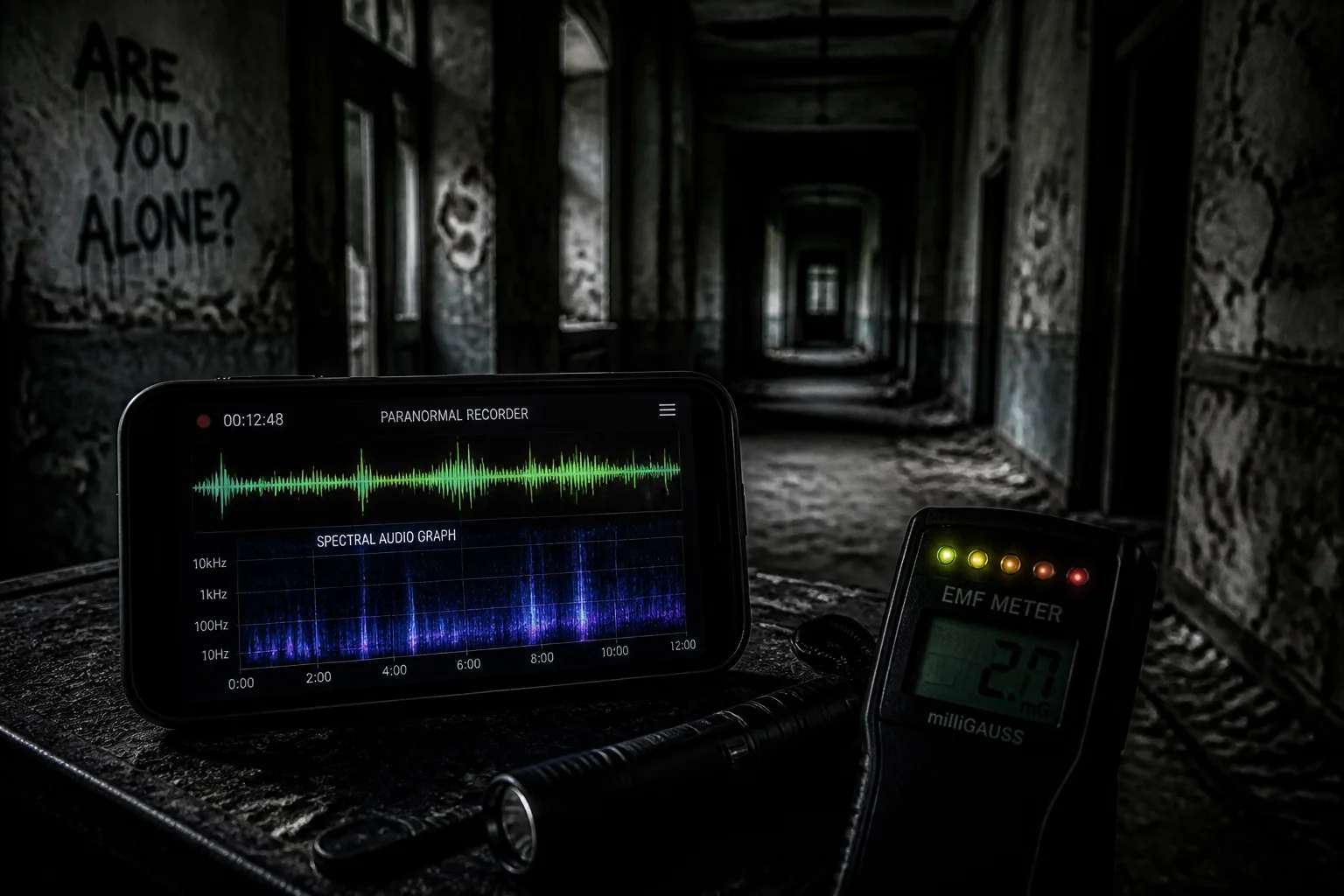
For analysis, the most helpful tools are usually the simplest ones. You want a reliable audio editor that lets you inspect waveforms, zoom into short sections, and compare raw and processed versions side by side. A spectrogram can be especially useful because it shows frequency content over time, making sudden peaks or unusual bands easier to spot.
You may also want basic cleanup tools such as gentle noise reduction, high-pass filtering, and normalization, but the key word is gentle. Cleaning audio should help you hear what is already there, not create a new version of the clip that sounds more dramatic. A good workflow is to keep one untouched master file and do all experiments on copies.
If you are sharing findings online, transparency matters more than effects. Show the raw clip if possible, then show any enhanced version, and explain exactly what was changed. If a tool makes the whisper clearer but also introduces a phrase that was not present before, the enhancement may be helping your imagination more than your evidence.
How to Use Spectrograms and Waveform Editors Without Over-Processing
A waveform editor shows amplitude over time, which helps you find spikes, pauses, and abrupt transients. A spectrogram goes deeper by showing how frequencies evolve. Together, they are valuable for spotting whether a suspicious sound behaves like speech or like environmental noise.
But the visuals can also mislead you. If you stare at a spectrogram long enough, it becomes tempting to see shapes that confirm your theory. So use the display as a diagnostic aid, not as proof by itself. Look for whether the sound has coherent formants, whether the frequency pattern is stable across repeated listens, and whether the timing makes sense relative to the room.
Do not over-process. Heavy noise reduction can pull noise floor artifacts into focus and make a clip seem more articulate than it was. Time stretching and extreme equalization can also distort vowels and consonants into something more word-like. The best workflow is often: inspect raw, apply minimal cleanup, compare, and then decide what can honestly be claimed.
When Audio Enhancement Helps and When It Creates False Evidence
Enhancement is useful when it helps expose a real signal that is already present but buried. It is harmful when it manufactures detail. That difference sounds obvious, but in EVP analysis it is easy to cross the line without noticing. Once a clip sounds clearer after processing, people often assume the clarity reveals truth. Sometimes it does. Sometimes it only reveals the filter’s side effects.
A good rule is to ask whether the enhancement improves intelligibility without changing the identity of the sound. If a faint noise still sounds like the same faint noise after a mild adjustment, that is helpful. If the same noise becomes a clear sentence only after heavy treatment, you should be skeptical. Enhancement should reduce uncertainty, not just produce a more satisfying interpretation.
This is why raw files are so important. Without them, no one can check whether the final clip is a faithful representation or a polished artifact. If your goal is credibility, the raw material is part of the evidence.
How to Share EVP Clips Credibly with Context, Timestamps, and Raw Files
When you share an EVP clip, context is everything. Include the timestamp, location, recording device, format, and any environmental conditions that could matter. Tell viewers what happened before and after the moment in question. If there was a door slam three seconds earlier or a truck passing outside, say so. That honesty builds trust, even when the clip remains mysterious.
If possible, provide the raw file alongside any edited version. Also explain your analysis process in plain language. Did you listen at normal speed first? Did you compare multiple playback speeds? Did you ask independent listeners to interpret the clip without leading them? These details help others judge the strength of the claim rather than just the drama of the sound.
If you are recording with an app like Ghost Detector: Ectify, it can be useful for capturing session history, timestamps, and an entire audio record of your investigation in one place, especially if you want to review the experience later or share it with others. Just remember that documentation features are only as good as the discipline behind them, so always pair the app with careful notes and raw audio preservation. Product link: https://findthe.app/ectify-fc72z0
Final Takeaways: How to Train Your Ear Without Fooling Yourself
A genuine ghost scream, if such a thing is ever captured, should be treated as an evidence problem first and a spooky moment second. That means resisting the urge to decide based on feeling alone. Train yourself to look for alternative explanations, recognize audio artifacts, and separate environmental noise from actual vocal structure.
The best investigators are not the people who hear the most ghosts. They are the people who know how easily the human ear can misfire and who build habits that protect them from their own expectations. Record cleanly, preserve raw files, document conditions, and ask other listeners to judge independently. If a clip still stands up after all that, then it is worth taking seriously.
In the end, the strongest paranormal audio evidence is not the one that sounds the scariest. It is the one that survives the most careful listening.
