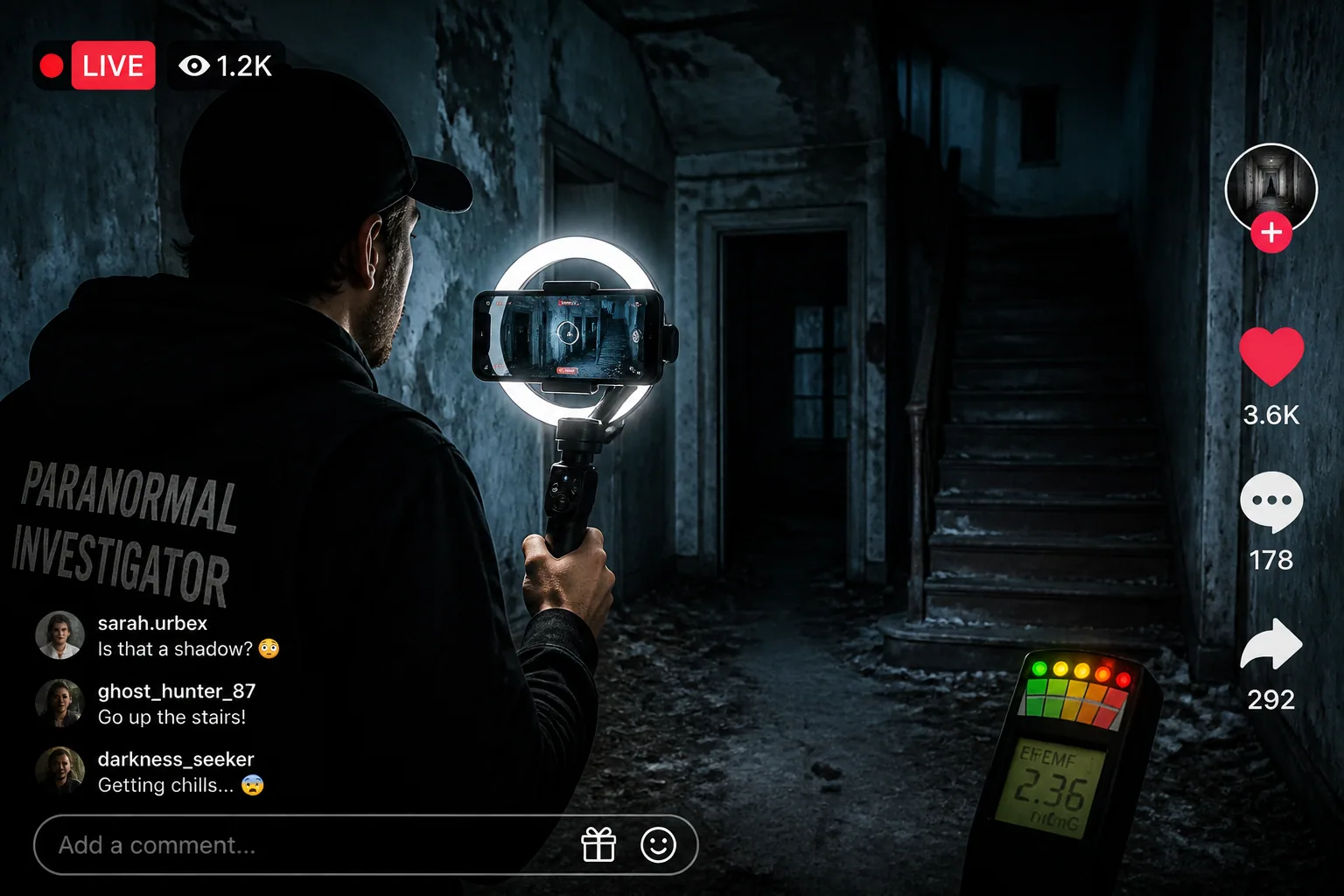
When Ghosts Go Viral: How Social Media Shapes Modern Paranormal Investigations
Paranormal investigations used to live mostly in long-form TV episodes, forum threads, and grainy documentary clips. Now they are being remade for TikTok, Instagram Reels, and YouTube Shorts, where a haunting has to compete with dance trends, comedy, and breaking news in the same scroll. That shift changes everything. The most successful ghost-hunt content is no longer just about what was captured. It is about how quickly the viewer is pulled in, how clearly the moment is framed, and how easily the clip can be shared as a dramatic digital narrative.
This is where modern paranormal media becomes fascinating. Creators are trying to preserve evidence while also satisfying platforms that reward suspense, speed, and repeat viewing. Audiences want chills, but they also want proof. Algorithms want engagement, but they do not care whether a clip is carefully documented or carefully staged for maximum retention. The result is a strange new middle ground where investigation, performance, and entertainment often overlap.
Why Paranormal Content Thrives on Short-Form Social Media
Short-form platforms are almost built for ghost stories. A paranormal clip usually begins with a question, a dark hallway, a noise, or a promise that something impossible is about to happen. That is exactly the kind of opening that stops a thumb mid-scroll. Unlike a long YouTube documentary, a 20 to 60 second video does not have time to wander. It has to suggest tension immediately, then pay it off fast.
Research on viral TikTok content helps explain why this format works so well. An analysis of 13.5 million TikTok clips found that viral-tier videos commonly use burned-in captions, often animated, and tend to rely on a project, product, or outcome showcase hook. The median viral video length in the public web sample was about 41 seconds, and successful clips often used 8 to 12 hashtags rather than only a few. The same study also found that third-person narration or perspective appeared in about 77.8% of viral clips, outperforming first-person story-openings. Source: https://www.opus.pro/blog/anatomy-of-a-viral-tiktok-2026
That pattern maps neatly onto ghost content. Instead of starting with, “I think my house is haunted,” the stronger opening is often, “We found this in the basement,” or “Watch what happens when the motion sensor goes off.” The content feels more immediate because the viewer is given an outcome to chase. In paranormal media, curiosity is the engine, and short-form platforms are optimized to keep that engine running.
The Anatomy of a Viral Ghost-Hunt Clip
A viral ghost-hunt clip usually has a very specific structure. It introduces a location, establishes a threat or mystery, and then delivers a visual or audio cue that feels just ambiguous enough to spark debate. The best clips often do not fully explain themselves. They leave room for comments, rewatches, and speculation. That ambiguity is not an accident. It is a feature.
Common ingredients include grainy footage, dim lighting, sudden camera movement, a whispered reaction, and some kind of eerie sound that is hard to identify at first listen. These elements work because viewers are not only watching the clip. They are also interpreting it. A study on paranormal storytelling and “empty spaces” showed that grouping, camera movement, verbal narration, and spatial cues all help frame an event as paranormal or mundane. In other words, the story around the evidence is often as important as the evidence itself. Source: https://www.sciencedirect.com/science/article/abs/pii/S0378216617300929
That means a hallway can look terrifying in one edit and ordinary in another. A creak can become a spirit response if the audio is isolated and amplified. A shadow can become proof if the camera lingers long enough. The anatomy of a viral clip is therefore partly technical and partly psychological. It is built to make uncertainty feel thrilling.
Hooks, Cuts, Captions, and Suspense: Storytelling That Drives Views
The strongest paranormal clips do not just show something strange. They tell viewers how to feel about it. The hook may be a caption like “We should have left immediately,” or a voiceover that frames the moment as the worst night of the investigation. These setups work because they create stakes before the evidence appears.
Captions matter more than many creators realize. Viral TikTok research shows that burned-in captions are present in most high-performing clips, and animated text is also extremely common. That is especially useful for paranormal content because viewers often watch without sound at first. A caption can establish the premise, tease the reveal, and reinforce the emotional tone even before the audio is turned on. Source: https://www.opus.pro/blog/anatomy-of-a-viral-tiktok-2026
The cuts matter too. Fast pacing can make a clip feel urgent, but too many cuts can make the evidence seem suspicious. This is where paranormal creators walk a fine line. They want suspense, but they also want to appear credible. A well-edited video can increase immersion, yet overly polished editing can trigger skepticism, because viewers may assume the most dramatic moment was enhanced or manufactured.
That tension is why some of the most effective creators lean on a serious, professional delivery. The same TikTok analysis found that serious or professional tone paired with thought-provoking framing is common among successful clips. In paranormal media, that can translate into a calm investigator speaking directly to the camera, rather than yelling over every noise. Ironically, restraint often makes a clip feel more believable.
When Evidence Becomes Entertainment
The moment a paranormal clip is designed for virality, evidence begins to compete with entertainment. That does not automatically make the content false, but it does change the incentives. If a clip performs better when the event is mysterious rather than fully explained, creators may be tempted to keep the ambiguity alive, even when they have more context.
This is one reason credibility has become such a central issue in paranormal media. A 2024 content analysis of 50 highly viewed YouTube videos about hauntings and UFOs found that most videos featured explicit paranormal claims, more than half included purported footage of paranormal phenomena, but almost none of the haunting videos cited scientific sources. The same study also found that YouTube use, along with viewing paranormal documentaries and reality shows, was a predictor of belief in hauntings among U.S. respondents. Source: https://journals.sagepub.com/doi/abs/10.1089/cyber.2023.0667?cf-mal-redirected=true
That finding matters because it shows how digital storytelling can shape belief. When repeated exposure normalizes certain visual tropes and narrative structures, viewers begin to treat them as familiar markers of authenticity. A shaky camera, a whispered reaction, and a dark doorway may be enough to trigger the sense that something real is happening. But familiarity is not the same as verification.
This is where ethical investigators need to be careful. Entertainment is not the enemy, but it should not be mistaken for proof. A clip can be compelling and still remain inconclusive. In fact, the most honest paranormal creators are often the ones who are willing to say exactly that.
How Editing Can Strengthen or Distort Paranormal Claims
Editing is one of the most powerful tools in paranormal content, and also one of the easiest ways to mislead. A longer pause can make a sound seem intentional. A tighter crop can hide a mundane explanation. A dramatic zoom can transform a reflection into a face. Even the order of clips can imply cause and effect where none exists.
At the same time, editing is not inherently deceptive. It can help organize evidence, preserve pacing, and make a session understandable for a wider audience. The problem is that the same techniques that improve clarity can also create false certainty. That is why many viewers now look for signs of authenticity beyond the edit itself.
Transparency has become a credibility signal. Timestamps, raw footage, visible metadata, and minimal compression artifacts all help a creator appear more trustworthy, especially when the claim is extraordinary. Yet the 2024 YouTube haunting-video study found that popular videos rarely included scientific sources, and few offered data-heavy or unedited evidence. That gap between what audiences want and what creators usually provide is one of the defining tensions of modern paranormal media. Source: https://journals.sagepub.com/doi/abs/10.1089/cyber.2023.0667?cf-mal-redirected=true
In practice, this means the cleanest edit is not always the best one. A creator who wants to preserve trust should consider showing the uncut version first, then offering a tighter version for social sharing. That way, the audience can enjoy the story without losing access to the underlying record.
What Audiences Now Expect From Credible Ghost Content
Viewers have become much more sophisticated about what counts as credible paranormal content. They no longer just ask, “Was that scary?” They ask, “Where was this filmed?”, “Can we see the full clip?”, “What happened before and after?”, and “Why is there no metadata?” The audience is performing its own investigation, and creators are now expected to anticipate that scrutiny.
A study on source credibility found that narratives featuring credible sources such as scientists, students, or credited witnesses were more persuasive, even when the paranormal topic stayed the same. The modality mattered less than the source. In plain terms, people are more likely to believe a story when they trust who is telling it. Source: https://www.tandfonline.com/doi/full/10.1080/15456870.2011.561153
That insight is highly relevant for ghost-hunting content. A creator does not need to sound academic to be credible, but they do need to present themselves with care. Clear explanations, consistent methodology, and a respectful tone can matter more than exaggerated reactions. Audiences often notice when someone appears to be genuinely investigating rather than simply performing fear.
Recent Facebook discourse research also found that paranormal investigators frequently emphasize professionalism and credibility in how they present themselves, especially when producing evidence and engaging with skeptics. At the same time, public discussion often becomes combative, with tone attacks and ad hominem arguments appearing when claims are challenged. Source: https://journals.sagepub.com/doi/10.1177/02762366251384885
That is a useful reminder: credibility is not just about the clip itself. It is also about how the creator behaves when questioned. Skeptical comments are not a threat to a serious investigator. They are an opportunity to show process.
Viral Case Studies: What Worked, What Critics Questioned
When a paranormal video goes viral, the same qualities that make it popular can also make it controversial. Usually, the clip works because it delivers an emotionally legible moment: a figure at the end of a corridor, an unexplained whisper, an object moving without obvious cause. The audience understands the threat instantly, and the clip becomes easy to summarize, remix, and discuss.
Critics, however, often focus on what the clip leaves out. Was the room already noisy? Was there a visible draft? Was the supposed reaction filmed after the fact? Did the creator cut away before the most important context? These questions are not cynical by default. They are part of healthy media literacy, and they are especially important in a genre built on uncertainty.
The best case studies teach the same lesson: a viral clip may succeed because it is emotionally efficient, but that efficiency can also simplify a complex investigation into a single spectacle. Ethical creators should treat that as a warning, not a goal. If a clip becomes popular, the responsibility to preserve context becomes even greater.
The Algorithm Effect: Why Certain Hauntings Get Seen
Algorithms reward signals that are easy to measure: watch time, rewatches, comments, saves, shares, and completion rates. Paranormal content performs well because it naturally generates those signals. A viewer pauses to inspect a shadow. They replay the sound. They comment with a theory. They send it to a friend. Every one of those actions tells the platform that the clip is worth showing again.
This is also why certain types of haunting are more visible than others. Cleanly packaged, visually understandable, emotionally intense clips travel farther than slow, methodical investigations. A full-night session with careful notes may be more honest, but it is harder to compress into a scroll-stopping moment. The platform therefore nudges creators toward dramatic highlights and away from slow evidence-building.
Research on TikTok virality also suggests why certain formatting choices keep appearing. Viral clips are often concise, strongly captioned, and packed with clear framing. They often use popular tags as discovery shortcuts. In practice, that means paranormal content benefits from the same structural discipline as other viral genres, even if the subject matter feels niche or spooky.
SEO, Hashtags, and Rising Search Trends in Paranormal Media
Discoverability is no longer just about platform feeds. It is also about search. Viewers actively look for haunted house tours, ghost caught on cam, evidence of spirits, and other long-tail paranormal phrases. SEO tools such as YouTube keyword research platforms show that these niche queries continue to hold steady or rising interest, while competition remains lower than in broad horror categories. That gives smaller creators a real opportunity. Source: https://ahrefs.com/youtube-keyword-tool
Hashtag strategy matters as well. Recent hashtag research shows that #ghost, #ghoststories, #ghosthunting, #paranormal, and #spooky remain among the most common tags across TikTok, Instagram Reels, and YouTube Shorts, with seasonal spikes around spooky season and haunt-related terms. Source: https://posstr.com/hashtags/ghost
For creators, the lesson is simple. Use a mix of broad discovery tags and more specific intent-based keywords. A clip about a haunted basement should not only rely on #ghost. It should also use descriptive language in the caption, on-screen text, and spoken narration so that search engines and platform indexing systems can understand the topic. The best SEO is not gaming the system. It is making the content legible to both humans and algorithms.
If a creator wants a practical way to document investigations while also producing shareable clips, a tool like Ghost Detector: Ectify can help turn a smartphone into a more organized recording workflow, especially because it includes session history, timestamps, and shareable audio exports: https://findthe.app/ectify-fc72z0
How Creators Can Stay Authentic While Still Growing
Growth and authenticity do not have to be opposites. The most sustainable paranormal creators are usually the ones who build trust first and virality second. That means being clear about what is known, what is suspected, and what is still unexplained. It also means resisting the urge to overstate every bump in the night as proof of a spirit.
A good starting point is to keep raw footage archived, even if the public clip is edited for pace. Include timestamps. Preserve original files when possible. Note the location, time, weather, and any environmental factors that could matter. If audio is enhanced, say so. If a clip is cropped, explain what was removed and why. These small habits can make a huge difference in how a creator is perceived over time.
Creators should also think carefully about narration. Strong narration does not have to mean sensational narration. A calm, thoughtful explanation can actually build more confidence than a string of exaggerated reactions. The TikTok research on viral styles suggests that professional delivery and thought-provoking tone often outperform messy, overly chaotic presentation. For paranormal creators, that is good news. Serious does not have to mean boring.
Best Practices for Transparent, Ethical Ghost-Hunt Documentation
Ethical documentation starts with a simple question: if this clip were challenged, would you be able to defend it honestly? If the answer is no, the content probably needs more context before it is published.
A few best practices stand out. First, separate evidence from interpretation. Show the raw event, then clearly label your theory. Second, keep unedited copies and retain metadata whenever possible. Third, avoid cutting away from critical context, such as who was present, what equipment was used, and what happened immediately before and after the moment. Fourth, acknowledge mundane explanations if they exist. A credible investigator is not weakened by uncertainty. They are strengthened by it.
Creators should also be careful not to dismiss skeptics reflexively. The Facebook discourse study suggests that public debate around paranormal claims can become personal very quickly, but ad hominem responses do nothing to improve credibility. If a viewer suggests a draft, a reflection, or a hidden sound source, the response should be calm and specific, not defensive. That professionalism becomes part of the evidence too.
Ultimately, transparency is not anti-entertainment. It simply gives the audience more reasons to trust the story being told. And in paranormal media, trust is a form of currency.
The Future of Paranormal Investigations in the Age of Virality
The future of paranormal content will probably be more interactive, more searchable, and more visually standardized than ever before. Creators will continue to learn what types of hooks, captions, pacing, and tags perform best. At the same time, audiences will keep raising the bar for credibility, especially as AI-generated edits and synthetic media become easier to produce.
That means the next generation of paranormal investigators will need to do two things at once. They will need to make content that travels well in feeds, and they will need to preserve enough raw evidence that the content can withstand scrutiny. The best creators will not be the ones who claim the most. They will be the ones who document the most carefully, explain the most honestly, and still know how to tell a compelling story.
In that sense, social media has not killed paranormal investigation. It has forced it to mature. Ghosts may go viral, but credibility still has to survive the scroll.
