When the Weather Whispers: How Weather Conditions and Forecasts Impact Your Ghost Hunting Results
Weather is one of those things ghost hunters often notice only after a session goes sideways. The rain gets heavier, the wind starts rattling a window, the EMF meter spikes near a damp wall, and suddenly everyone is asking whether the house is active or whether the environment is simply playing tricks on the equipment. The truth is that weather can shape paranormal investigations in two very different ways. It can create an atmospheric mood that makes a location feel more charged, and it can also produce measurable effects on sensors, audio, thermal cameras, and even human perception.
For beginner and intermediate investigators, understanding the difference between mood and mechanism is a major step toward cleaner evidence. A dramatic sky might make a session feel intense, but that does not mean it has produced a real anomaly. On the other hand, humidity, barometric pressure shifts, wind, temperature swings, and storm systems can absolutely influence how devices behave and how people interpret what they see, hear, and feel. If you want more credible results, weather awareness is not optional. It is part of the investigation method.
Why Weather Matters More Than Most Ghost Hunters Realize
Weather changes the environment around you in ways that can be easy to miss in the moment. A cold draft coming through a loose door frame can feel like a paranormal touch. A humidity spike can make a room feel heavy and cause subtle sensor issues. A sudden drop in pressure before a storm can coincide with a flurry of strange reports, which leads people to assume something supernatural is increasing activity. In reality, the environment itself may be doing the heavy lifting.
According to Pacific Paranormal’s baseline guide, fluctuations in temperature, humidity, and barometric pressure are often overlooked, even though they can drive reports of cold spots, touches, dizziness, and skin-crawling sensations around doors, windows, and structural junctions: https://www.pacificparanormal.com/index.php/menu-btn-team-resources/133-baseline-readings That matters because many of the sensations people label as paranormal begin with ordinary airflow, moisture movement, and changing room conditions. When a location becomes damp or drafts intensify, the body notices.
That does not mean weather is only a source of false positives. Many investigators believe that unstable conditions can create windows where reports of activity increase, especially when storms are approaching or when night conditions make a location more isolated and difficult to interpret. The key is to stop treating weather as background noise and start treating it as a variable that should be recorded every time.
The Science Behind Weather, Sensors, and Strange Readings
Most paranormal tools are not magic instruments. They are sensors reacting to physics. EMF meters detect changes in electromagnetic fields. Thermal cameras measure differences in infrared energy. Audio recorders capture vibration and pressure changes. Spirit boxes and EVP sessions are especially vulnerable to interference because they rely on a noisy environment and human interpretation. If weather alters the physical environment, the tools will often reflect that change.
Wind can move equipment, rattle loose objects, and create contact electrification that looks like an unexplained spike. Kestrel Instruments notes that EMF should be validated alongside atmospheric signals, and that practical field steps such as using windshields on mics, keeping EMF meters stable, and avoiding open drafts during EVP sessions can reduce artifacts: https://kestrelinstruments.com/blog/ghost-hunting-with-kestrel-instruments-a-scientific-approach-to-the-supernatural In other words, the environment and the reading are often connected.
Humidity and heat create another layer of trouble. High temperatures can shorten battery life, especially for lithium-ion and alkaline cells, while humidity can lead to condensation on circuitry and increased conductivity across insulators. US Ghost Adventures has written about how summer heat affects ghost hunting gear, and the same concerns apply broadly to devices used in the field: https://usghostadventures.com/americas-most-haunted-trending/how-the-summer-heat-can-affect-your-ghost-hunting-gear/ If your gear is acting oddly on a humid night, that does not automatically mean the location is haunted. It may mean the hardware is struggling.
How Rain, Wind, and Humidity Affect EVP, Spirit Boxes, and EMF Meters
Rain changes everything. It introduces moisture, changes sound behavior, and often creates more background noise through gutters, windows, roofs, and saturated ground. For EVP sessions, that means a recording can pick up more indistinct ambient noise, making it harder to separate a possible voice from rain impact, water runoff, or distant traffic amplified by wet surfaces. For spirit boxes, extra noise in the environment can make random syllables feel more meaningful than they are.
Wind is just as disruptive. It pushes against microphones, causes low-frequency rumble, and can physically jostle handheld devices. If a meter shifts in your hand, the reading can jump. If a cable brushes against clothing, you may think you caught an audio anomaly. If a breeze passes through a partially open doorway, people in the room may feel a sudden chill and interpret it as a presence. The experience is real, but the cause may be simple airflow.
Humidity is subtler, but it can be one of the biggest culprits in misleading investigations. Moist air changes how sound travels, how surfaces hold heat, and how equipment reacts. High humidity can produce visual scattering that contributes to apparent orbs, haze, and strange reflections. US Ghost Adventures notes that moisture and high humidity can make dust, reflection, and visual anomalies more likely to be mistaken for paranormal activity: https://usghostadventures.com/americas-most-haunted-trending/how-the-summer-heat-can-affect-your-ghost-hunting-gear/ That is why an orb captured on a sticky summer night is not automatically compelling evidence.
For EMF meters, moisture is especially important because condensation and conductivity can produce erratic behavior. If a device is cold and moved into warm humid air, water can form on or inside the sensor housing. That can create false spikes, drift, or unstable readings. When a location is damp, it is wise to treat every EMF anomaly as provisional until you can reproduce it under controlled conditions.
Barometric Pressure, Temperature Swings, and Thermal Imaging Challenges
Barometric pressure deserves more attention than it usually gets in ghost hunting discussions. When pressure drops quickly, usually ahead of storms, investigators often report a surge in activity. Silent Slayer Tour logs note that sudden barometric pressure changes are commonly associated by investigators with heightened paranormal activity and that some believe these drops may distort electromagnetic fields or make presences easier to perceive: https://silentslayertours.com/blog/f/how-weather-really-affects-ghost-hunting Whether you see that as a paranormal trigger or simply a coincidence, it is worth tracking because pressure changes can affect both the body and the environment.
People often feel pressure shifts physically. Some get headaches, fatigue, or a sense of unease. In a haunted setting, that can prime the mind to interpret ordinary sensations as extraordinary. If the room feels tense right before a storm, the team may become more suggestible, more alert to noise, and more likely to connect unrelated events into a pattern.
Temperature swings create another problem for thermal imaging. Infrared cameras are excellent tools, but they are not immune to false positives. Thermal fade, reflective surfaces, and quick transitions between hot and cool environments can all distort readings. US Ghost Adventures has noted that heat buildup and reflections can affect thermal cameras, producing misleading visuals and mirage-like distortion, especially during hot days or when a device moves from one extreme to another: https://usghostadventures.com/americas-most-haunted-trending/how-the-summer-heat-can-affect-your-ghost-hunting-gear/ If you move from an air-conditioned car into a humid exterior location, your camera may need time to stabilize before the data becomes useful.
The practical lesson is simple. Thermal data is only as good as the environmental context around it. Whenever the air temperature is unstable, surfaces are unevenly heated, or sunlight has recently hit a wall, you should assume the thermal image may be misleading until proven otherwise.
Moon Phases, Cloud Cover, and the Psychology of Paranormal Perception
Moon phases are one of the most discussed weather-adjacent variables in ghost hunting, partly because they shape the feel of an investigation and partly because some datasets suggest a pattern. A 26-year analysis of 723 reports in Tasmania found significantly more reports around full moon and new moon phases, especially when geomagnetic activity is low, according to Dubaj and Mowbray’s exploratory study: https://www.parapsychologypress.org/jparticle/jp-83-2-193-207 That kind of result is intriguing, but it is not the same as proof of causation.
The Australian Parapsychological Research Association also reviewed a smaller controlled dataset and found that events were still skewed toward periods near new and full moons, while cautioning that psychological expectations and increased nighttime observation may inflate reports: https://www.parapsychology.org.au/correlation-of-haunt-phenomena-with-moon-phase/ That warning matters. More people go out at night when the moon is bright or when the sky feels especially dramatic, which means more eyes, more attention, and more opportunities to mistake normal events for anomalies.
Cloud cover changes the psychology of the session too. A bright full moon can cast sharp shadows that move across walls and trees, creating movement that feels deliberate. Heavy cloud cover can eliminate visual cues, making any light source, reflection, or sudden motion feel more striking. In both cases, the mind works harder to fill in gaps. That is where ghost hunters can easily overread the scene.
Some investigators also track geomagnetic or space weather activity. Will County Ghost Hunters Society says disturbances in Earth’s magnetic field, sometimes tied to solar phenomena, may correlate with paranormal reports, especially when combined with lunar cycles: https://www.theghostpage.com/lunar-cycle Even if you remain skeptical of a direct paranormal link, monitoring space weather can still be useful because it adds another layer of environmental context.
Using Forecasts, Radar, and Moon Calendars to Plan Better Investigations
The smartest way to work with weather is to plan around it. Forecast tools, radar maps, moon phase calendars, and even space weather indices can help you choose nights when conditions are more stable and easier to interpret. Silent Slayer recommends using weather forecasts to select windows with low precipitation, steady air, clear skies, and favorable moonlight so investigators can reduce false positives and improve the odds of capturing actual anomalies: https://silentslayertours.com/blog/f/how-weather-really-affects-ghost-hunting
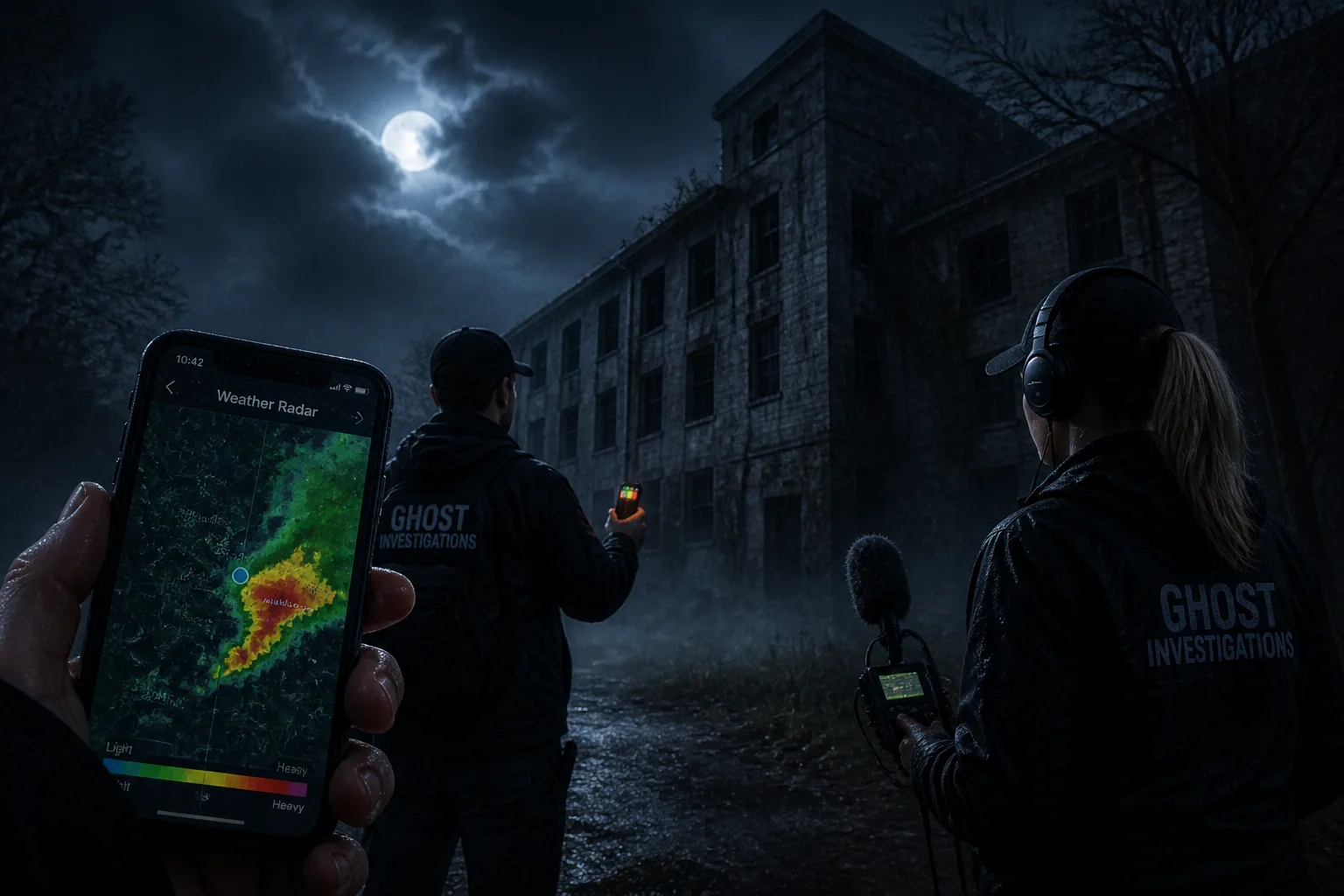
Before a session, check the basic forecast first. Look at rain probability, humidity, wind speed, temperature swings, and pressure trends. If you are investigating outdoors, radar matters because storms can move in quickly and change the soundscape of a location in minutes. If you are indoors, the same information still helps because a building under weather stress can behave differently. Doors creak, walls expand and contract, and drafts become more pronounced.
Moon calendars help you plan visibility and expectation. If you know you are going out during a bright moon, account for stronger shadow play and more visual ambiguity. If you are working a new moon, prepare for lower ambient light and greater dependence on artificial light, which can also create reflections and artifacts. If possible, record the moon phase, cloud cover, barometric pressure, and wind conditions alongside your evidence notes so later review has real context.
This is also a good place to mention a practical session tool like Ghost Detector: Ectify, which can help you record and review investigations from your phone while keeping session history organized: https://findthe.app/ectify-fc72z0. A structured history is useful because weather-linked patterns are much easier to spot when every session has timestamps and consistent notes.
Case Examples: When Weather Triggered Activity or False Positives
Consider a rainy exterior investigation where a team reports repeated EMF spikes near an old stone wall. After review, the spikes line up with a power line nearby, but the team had not noticed that wind gusts were pushing a loose cable against a metal bracket. The weather did not cause the phenomenon, but it changed the way the equipment and the structure interacted. That is a classic false positive scenario.
Or imagine a humid summer attic session. The team captures what looks like an orb crossing the frame, and the thermal camera shows a moving warm patch near a vent. Later, they realize the orb was likely suspended dust and moisture in the beam of a light, while the thermal reading was affected by hot roof material and changing airflow. This is exactly the kind of setting where high humidity and heat can inflate both visual and thermal anomalies.
Now look at a different example. A group investigates a historic house on the night before a severe storm. Pressure is dropping, the air feels unusually still, and several team members report headaches, unease, and a sense that something is present. They capture a series of faint audio oddities, but the environment is also unusually tense, and everyone is hyperfocused. The result may still be interesting, but without careful controls it is impossible to know whether the weather sharpened perception, affected equipment, or genuinely coincided with unusual activity.
The main takeaway from these examples is not that weather invalidates paranormal work. It is that weather complicates it. If you do not document the conditions, you cannot tell whether the anomaly came from the location or from the atmosphere around it.
How to Adapt Your Methods in Bad or Unstable Conditions
When the weather is messy, your method has to become more disciplined. Start by stabilizing your equipment. Put microphones in windshields, keep tripods weighted, and avoid holding meters loosely where movement can influence readings. If the ground is wet or uneven, elevate sensitive gear and protect cables from puddles and foot traffic. A stable setup produces cleaner data even when the environment is chaotic.
For EVP sessions, choose sheltered spaces whenever possible. Close unnecessary drafts, silence devices that create noise, and note any background weather sounds that could contaminate the recording. If wind is unavoidable, keep your expectations modest and review the session with extra skepticism. The same applies to spirit box sessions, where random radio fragments can sound meaningful simply because the weather has created a noisier, more dramatic atmosphere.
For thermal imaging, let the camera acclimate before you trust its output. If the device has just moved from one temperature extreme to another, give it time. Avoid pointing it directly at sun-warmed surfaces, reflective metal, or rain-slick areas until you understand the local heat pattern. In unstable weather, short controlled sweeps are usually better than prolonged scanning of one misleading surface.
For EMF work, create a baseline before you begin and repeat it during the session. If the environment is humid, damp, or electrically noisy, treat fluctuations with caution. A reading that appears only once, in one position, and during one gust of wind is not strong evidence. Reproducibility is the standard that matters.
Safety First: Storms, Lightning, Slippery Terrain, and Equipment Protection
No ghost hunt is worth getting hurt for. If thunderstorms are in the area, the safest decision is to postpone. Lightning can strike miles from the storm center, and wet ground increases the risk around outdoor locations, fences, metal structures, trees, and waterlogged trails. If radar shows a fast-moving system or local alerts are active, the session should end early.
Slippery terrain is another overlooked hazard. Historic sites, cemeteries, wooded trails, and abandoned buildings all become more dangerous in rain, fog, or freezing conditions. Wet steps, broken masonry, loose gravel, and poor visibility can cause injuries long before any paranormal issue appears. Investigators should wear suitable footwear, carry adequate lighting, and avoid unstable structures altogether.
Equipment protection matters too. Use sealed bags, lens covers, and dry storage when conditions are damp. Keep spare batteries warm and dry, since heat and moisture can reduce reliability. If condensation forms, do not power up delicate devices immediately. Let them acclimate and dry first. A damaged camera or meter does not help your evidence, and it can create problems that look like paranormal interference later.
A weather-aware team also knows when to leave. If wind becomes extreme, rain starts soaking equipment, or thunder is close enough to hear, the investigation has shifted from research to risk management. Safety should always win.
Building a Weather-Aware Investigation Routine for More Credible Results
The best ghost hunters are not the ones who get the most dramatic night. They are the ones who understand the conditions well enough to interpret what they captured. A weather-aware routine makes that possible. Start every session by checking forecast, radar, moon phase, and pressure trends. Record temperature, humidity, wind, and cloud cover before you begin. If the location is outdoors, note how the weather is changing in real time. If you are indoors, log how the structure responds to the outside environment.
Over time, these notes help you see patterns. You may discover that certain kinds of readings happen only during storm buildup, or that specific audio artifacts appear whenever wind moves through a corridor. You may also find that your strongest evidence comes on calm, dry nights when the gear is stable and the environment is easier to rule out. Either outcome is valuable because both sharpen your judgment.
Weather will always be part of the ghost hunting experience. Sometimes it sets the mood. Sometimes it explains the anomaly. Sometimes it seems to line up with the moment something unusual happens. The goal is not to ignore weather or romanticize it, but to work with it intelligently. If you do that, your investigations become safer, cleaner, and far more credible.
