Why Ghost Hunters Should Embrace Acoustic Ecology: How Natural Soundscapes Shape Paranormal Evidence
If you spend enough time in abandoned houses, cemeteries, forests, factories, or historic buildings, one thing becomes obvious very quickly: most locations are never truly silent. They breathe, hum, creak, hiss, and rattle in ways that can easily be mistaken for activity with intent. That is exactly why acoustic ecology should matter to ghost hunters. It teaches investigators to listen to a site as a living sound environment, not just a backdrop for spooky moments.
For intermediate and advanced investigators, this is not just a technical upgrade. It is a credibility tool. When you understand how sound travels through a location, what kinds of noise recur, and which frequencies are most likely to distort speech, you can review EVP, Spirit Box sessions, and ambient recordings with far more confidence. You also reduce false positives and create content that is more transparent for your audience.
Why Acoustic Ecology Matters in Paranormal Investigation
Acoustic ecology is the study of how sounds behave within environments and how those environments shape what we hear. In paranormal investigation, that matters because many supposed anomalies are really the result of masking, distortion, or mishearing. A faint voice can be hidden by a passing truck. A knock can be a pipe contracting. A whispered word can be the result of wind sweeping across a microphone grille.
This is not a theory reserved for highly controlled labs. It shows up in real investigation conditions every night. Ambient noise in outdoor rural nighttime environments often sits around 32 to 35 dBA, while urban nighttime ambience can range from 40 to 50 dBA. Those differences matter because once the environment gets louder, the signal-to-noise ratio drops, and faint audio details are harder to separate from the background. Source: https://dnr.alaska.gov/mlw/mining/reclamation/nanuuq/pdf/vol2socio.pdf
In other words, a location is not just a haunted site. It is an acoustic system. The better you understand that system, the better you can judge whether a sound is unusual, explainable, or actually worth preserving as evidence.
What Counts as a Soundscape: Natural, Human, and Mechanical Layers
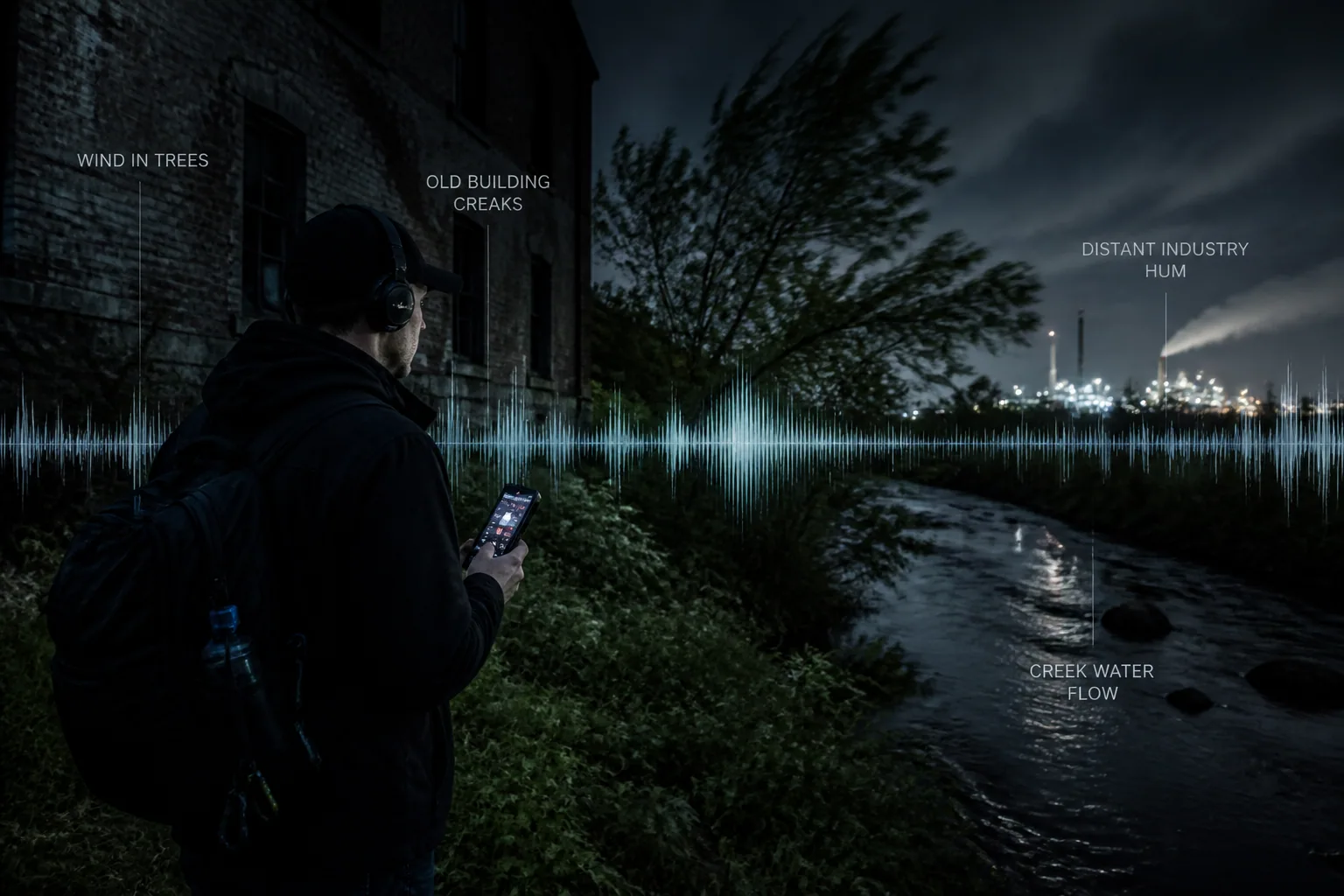
A soundscape is the full combination of sounds present in a location at a given time. In paranormal work, it helps to think in layers. Natural layers include insects, birds, wind, rain, water flow, distant thunder, and animal movement. Human layers include footsteps, speech, clothing rustle, coughs, and the movement of a team. Mechanical layers include HVAC systems, generators, traffic, refrigeration units, electrical hum, distant machinery, and building infrastructure.
These layers overlap constantly. A single investigation room may contain the low-frequency rumble of a road, the intermittent click of a cooling system, and the sharp, irregular pops of settling wood. Each of those can affect how a recorder captures speech-like material. The danger is not just volume. It is overlap. If noise energy sits in the same frequency range as speech, it becomes much harder to distinguish words from ambient texture. Speech’s most important acoustic energy is concentrated between 300 and 3,000 Hz, which is exactly where many environmental noises also cluster. Source: https://nonoise.org/library/whonoise/whonoise.htm
That is why a location can sound eerie without being paranormal. It may simply be acoustically busy. Once you label the layers correctly, the investigation becomes less about reacting to every noise and more about understanding how the site communicates through sound.
How Wind, Water, Wildlife, and Structures Mimic Paranormal Activity
Natural sound sources are some of the best imitators in ghost hunting. Wind can produce whistles, moans, rattles, and the sudden burst of noise that makes people think they heard a voice. Water can create rhythmic dripping or hollow echoes that resemble footsteps. Insects can generate high-frequency textures that are easy to mishear as whispering. Wildlife can produce scratchy, breathy, or directional sounds that seem to come from nowhere.
Structures are equally deceptive. Loose windows, aging floorboards, metal beams, chain-link fencing, and unstable doors can all generate sharp transients that sound like knocks or impacts. In older buildings, thermal expansion and contraction can cause creaks and pops that seem to move through a structure like footsteps. Even a distant machine may create a steady low-frequency hum that masks subtle details and makes listeners fill in missing information.
This is where the research on masking becomes especially useful. Steady maskers, like HVAC hum or distant machinery, reduce speech intelligibility by overlapping spectral content with speech. Fluctuating maskers, like traffic or wind gusts, are even more disruptive because they vary over time and across frequencies. Source: https://www.sciencedirect.com/science/article/pii/S0378595516303513
If you have ever reviewed a clip and thought a voice was present only to find that the same sound was caused by wind, a fan cycle, or a distant vehicle, you have already experienced acoustic mimicry in action.
The Psychology of Mishearing: Why Investigators Hear Voices in Noise
Ghost hunting is not just an audio challenge. It is also a perception challenge. When someone enters a session expecting paranormal communication, the brain becomes more likely to organize ambiguous sound into meaningful speech. This is called auditory pareidolia, and it is one of the most important concepts investigators should understand.
Research shows that when people are primed to expect paranormal voices, they report hearing voices more often in ambiguous audio such as white noise or degraded speech. They also disagree strongly on what they heard, which suggests recognition of speech where none objectively exists. Source: https://onlinelibrary.wiley.com/doi/full/10.1002/acp.3068
That matters because EVP review often happens after a high-emotion field session. The investigator is tired, excited, and already primed to find evidence. In that state, the brain is very good at completion. It will turn a half-formed syllable into a name, a hiss into a whisper, or a random transient into a reply. Better acoustic discipline does not remove the mystery. It simply keeps the mystery from being overclaimed.
Establishing an Audio Baseline Before You Start a Session
One of the simplest habits that can dramatically improve investigation quality is taking a baseline audio recording before you do anything else. Before asking questions, before running a Spirit Box, and before walking room to room, record several minutes of the location in a quiet, undisturbed state. Let the environment speak on its own.
A good baseline should capture the constant and recurring sounds of the site. Listen for HVAC cycles, water pipes, distant traffic, electrical buzz, birds, insects, and structural movement. If possible, record at more than one point in the building and at more than one time during the night, because some sources only appear intermittently. The point is to know what normal looks and sounds like so that abnormal has a reference point.
This baseline also helps with SNR awareness. Signal-to-noise ratio is crucial in EVP review because the louder and more overlapping the ambient sound is, especially in speech frequencies, the more likely a genuine faint signal will be masked or distorted. If you know your baseline is already noisy, you can interpret borderline audio far more conservatively.
How to Map a Location’s Recurring Sound Sources
Mapping recurring sound sources is basically building a sonic map of the location. Start by noting where each type of sound is strongest. A hallway may carry traffic rumble, while a basement may collect pipe noise. A corner room may amplify wind leakage, while an attic may expose roof movement and insect activity. Sound is never distributed evenly.
It helps to create a simple site log with time stamps and notes. Record when the boiler turns on, when the train passes, when the exterior gate rattles, or when the building settles. After a few sessions, patterns will emerge. You may find that a specific knock always occurs when the radiator heats up, or that a voice-like sound only appears during gusty periods near a broken window.
This kind of mapping also prevents investigators from attributing every repeat event to something mysterious. Repetition is often a clue to mechanics, not spirits. If a sound returns at the same interval, in the same location, and under the same conditions, you are likely dealing with a physical source that simply needs to be identified.
Using a Phone as a Serious Field Audio Tool
A smartphone is often dismissed as too basic for serious paranormal work, but that is not necessarily true. Used well, it can be a practical field audio tool for baseline captures, notes, quick comparisons, and review. The key is to treat it like an instrument rather than a toy. Hold it steady, keep it out of direct wind, and use it consistently so your recordings are comparable across sessions.
Phone apps can help you capture audio, monitor levels, and organize session time stamps. They also make it easier to document conditions in the moment, which matters when you later review a suspicious clip and want to know whether a door was open, the wind picked up, or another investigator was moving nearby. The phone is not perfect, but it is often the most accessible starting point for better field discipline.
If you want a more integrated paranormal workflow on mobile, a tool like Ghost Detector: Ectify can be a convenient companion for logging sessions, capturing audio, and organizing your evidence trail. You can learn more here: https://findthe.app/ectify-fc72z0
Best Budget Gear for Cleaner EVP and Ambient Recordings
Once you move beyond casual recording, a few affordable upgrades can make a major difference. An external microphone usually gives you better control over placement and reduced handling noise. A small windscreen can dramatically cut down on air distortion outdoors. A tripod or mount helps isolate vibration. Even a simple recorder with manual gain control can be a large step up from a raw, handheld phone capture.
The goal is not to build a studio in the field. It is to reduce avoidable contamination. A clean recording chain gives you a better chance of identifying whether a sound came from the environment, the investigator, or something genuinely unexplained. That clarity matters more than flashy gear. In fact, a modest setup used carefully is often more useful than expensive gear used carelessly.
Budget also matters because paranormal work often involves difficult environments. Dirty locations, cold air, moisture, and long night sessions can be hard on equipment. Simple, reliable tools that you know how to use are often the best choice for repeatable results.
How to Use Spectrograms and Waveforms to Review Evidence
A waveform shows amplitude over time. A spectrogram shows how energy spreads across frequencies over time. Together, they help you see what your ears might miss. That is especially helpful when investigating weak audio, overlapping voices, or sounds buried in noise. A clip that sounds like a whisper may show a very different structure when viewed graphically.
Spectrograms are particularly useful for identifying recurring environmental signatures. A constant hum, for example, may appear as a stable band. A short knock may show as a sharp vertical event. Wind noise may create broad, messy low-frequency movement. By comparing suspicious clips with baseline recordings, you can often spot whether the anomaly matches a known source or stands apart from it.
This matters because masking is not just about loudness. Background noise can reduce neural tracking of both acoustic amplitude fluctuations and semantic features of speech, making subtle details harder to detect as masking rises. Source: https://www.sciencedirect.com/science/article/pii/S0028393223001185
Separating Organic Ambience from Potential Anomalies
Organic ambience is the natural texture of a location. It is the mix of distant, soft, imperfect sounds that belong to the environment. Potential anomalies are sounds that do not fit the established pattern. The challenge is not to eliminate ambience entirely. That would make the recording unnatural and may even remove useful context. The challenge is to distinguish normal site texture from events that deserve attention.
A good rule is to ask three questions: Was the sound repeatable, was it localizable, and does it match a known source? If you can repeat the sound by revisiting the same room, if you can identify where it came from, and if it has a plausible environmental explanation, it is probably not paranormal. If it remains isolated, contextually strange, and unsupported by known causes, it becomes more interesting, though still not automatically paranormal.
This is where disciplined review protects your evidence. It keeps you from overcalling every oddity and helps preserve the few events that actually remain unexplained after a serious pass.
Making Spirit Box Sessions More Credible with Environmental Awareness
Spirit Box sessions are especially vulnerable to environmental contamination because they often combine fast-changing audio, radio fragments, and strong expectation. That makes it easier for listeners to hear words where the source is actually a station bleed, static burst, or ambient noise shaped into speech-like form. Acoustic awareness can improve the credibility of these sessions without stripping away their atmosphere.
Start by recording the session with the room baseline still active so you know what the environment was doing at the time. Avoid running the Spirit Box directly beside large mechanical sources or in gusty airflow. If a sound seems meaningful, note the exact second, replay it, and compare it against the nearby ambient texture. Very often, the environment itself provides the missing explanation.
This is also where investigator behavior matters. If you speak over the session, shuffle your feet, or move the device around too much, the audio becomes much harder to interpret later. A cleaner session is not only easier to review, it is easier to defend.
Common Audio False Positives in Haunted Locations
Many classic paranormal sounds have ordinary counterparts. Knocks may come from plumbing, tree limbs, or building expansion. Footsteps may be created by settling floors, rodents, or a second investigator outside the frame. Voices may be distant people, radio spill, or speech-like fragments created by noise itself. Doors may move because of pressure changes, draft paths, or uneven latches.
The most common false positives usually appear when a location is acoustically dense. Busy roads can cause low-frequency rumble that masks nearby speech. HVAC systems can create constant tonal layers that make a whisper seem more pronounced. Wind can produce syllabic textures that listeners interpret as words. Every one of these can become evidence if the team is not paying attention to the soundscape.
The research on priming is especially important here. When a listener expects paranormal communication, ambiguous audio is more likely to be interpreted as voice-like. Source: https://onlinelibrary.wiley.com/doi/full/10.1002/acp.3068
A Simple Field Workflow for More Reliable Paranormal Audio
A reliable workflow does not need to be complicated. Begin with a quiet baseline recording. Walk the site and identify repeated sound sources. Mark the noisiest rooms and note the quietest windows. Then run your investigation with as much consistency as possible in microphone placement, movement, and speaking style. When a suspect sound appears, document the time, location, weather, and any nearby mechanical activity.
After the session, review in two passes. First, listen for obvious environmental explanations. Second, compare any questionable audio against the baseline and against any spectrogram or waveform view you have available. If you can, have another investigator review the clip without telling them what you think it says. Independent review can help reveal how much suggestion influenced interpretation.
This approach will not remove mystery from the process. It will make the remaining mystery sharper, cleaner, and more credible.
How Content Creators Can Explain Sound Contamination to Their Audience
For paranormal content creators, transparency is part of the brand. Audiences today are more skeptical, more informed, and more likely to value honesty than exaggerated certainty. Explaining sound contamination does not weaken your content. It strengthens it because viewers can see that you understand what you are hearing and what could have caused it.
When you post clips, tell your audience what the baseline sounded like, what environmental sources were present, and why a particular sound remains interesting. If there was traffic outside, say so. If the building had a loud boiler, note it. If you ruled out a source, explain how you did it. This kind of commentary turns a simple clip into a credible case study.
That extra transparency also helps newer viewers learn better listening habits. Instead of training people to accept every odd noise as proof, you train them to think like investigators.
Why Better Sound Literacy Leads to Better Paranormal Evidence
Sound literacy is one of the most underrated skills in modern ghost hunting. It improves your ears, sharpens your review process, and makes your final evidence easier to defend. More importantly, it helps you separate genuine uncertainty from accidental misinterpretation. That is the real value of acoustic ecology in paranormal investigation.
When you understand how masking works, why speech disappears into noise, how expectation affects hearing, and how locations generate their own recurring sound signatures, you become a more careful investigator. You stop chasing every creak and start studying the site as an acoustic environment. You also give yourself a much better chance of identifying the few moments that remain truly unexplained.
In the end, better paranormal evidence does not come from louder claims. It comes from better listening.
