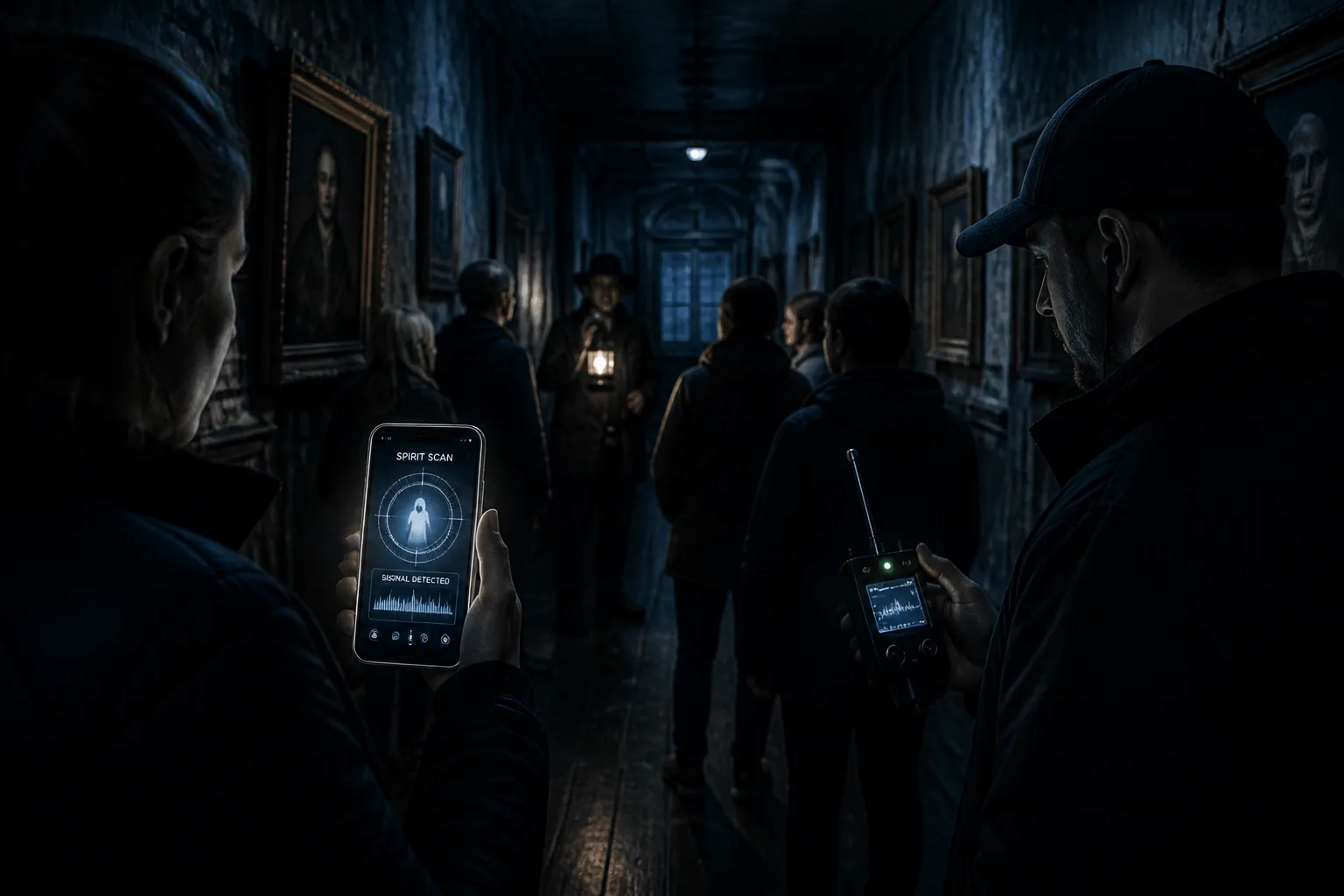
Why Haunted House Tours Feel Truer at Night: The Neuroscience Behind Paranormal Perception
There is a reason ghost stories, haunted house tours, and late-night EVP sessions feel more convincing after sunset. Night changes the way we see, hear, remember, and interpret the world around us. What feels like a sudden presence in a dark hallway may be a mix of reduced visual clarity, sharpened attention to sound, heightened emotion, and a brain that is doing what it always does: trying to make sense of incomplete information. In paranormal settings, that basic human tendency can make ordinary events feel charged, meaningful, and even supernatural.
Why Night Makes Haunted Experiences Feel More Convincing
The nighttime environment is naturally dramatic. Shadows lengthen, surfaces lose detail, and familiar spaces become harder to read. That matters because the brain is not a passive camera. It is an active prediction machine, constantly filling in gaps and testing expectations against incoming sensory data. In a haunted house, where people are already primed to expect strange events, the dark gives those expectations a much bigger role in shaping what gets noticed and how it gets interpreted.
This is also why the same location can feel mundane in daylight and deeply unsettling at night. In daylight, you can quickly verify whether a creak came from a loose stair, whether a shadow was a coat rack, or whether a cold spot came from an open vent. At night, those explanations are slower to arrive, and the brain tends to settle for the first pattern that seems to fit.
How Reduced Sensory Input Changes What We Notice
Low light does not just make things darker. It changes the way the visual system works. In very low light, or scotopic conditions, human vision becomes colorless and less sharp, especially in central vision, while peripheral vision becomes more important. Visual processing slows, and stimuli become more ambiguous. Research in iScience in 2024 describes exactly this shift, showing how high-order visual functions are altered in scotopic conditions: https://www.sciencedirect.com/science/article/pii/S2589004224001500
Even in dusk or dim indoor lighting, the visual system is operating in mesopic conditions, where rods and cones are both active but neither is working at full efficiency. According to an Annual Review of Vision Science paper from 2018, this mixed state increases uncertainty in shape, color, and motion detection: https://www.annualreviews.org/content/journals/10.1146/annurev-vision-091517-034055
That uncertainty matters for paranormal perception. A half-seen silhouette at the end of a corridor may not be enough for the brain to confidently identify, so it leans on expectation. A curtain becomes a figure, a stain becomes a face, and a moving shadow becomes evidence that something, or someone, is there.
The Brain’s Need to Find Patterns in Darkness
Humans are built to detect patterns quickly, even at the cost of sometimes seeing patterns that are not really there. In the dark, where visual input is degraded, this bias becomes stronger. The brain tries to complete missing information using context, memory, and expectation, a process known as perceptual filling-in. Komatsu’s review in Nature Reviews Neuroscience explains how the brain generates visual content in regions where direct input is absent: https://www.nature.com/articles/nrn1869
That mechanism is useful in everyday life because it helps us perceive a stable world from incomplete data. But in a haunted setting, it can turn darkness itself into a storyteller. A vague shape does not remain vague for long. It gets a label. A face in the corner. A figure by the stairs. A presence at the doorway.
Research also suggests that people with stronger paranormal beliefs are less able to discriminate signal from noise under ambiguous conditions, producing more false positives. A 2022 study in Consciousness and Cognition linked paranormal belief with a greater tendency to perceive signal in noise, especially when the sensory environment is degraded: https://doi.org/10.1016/j.concog.2022.103418
This does not mean believers are irrational. It means the brain is responding to uncertainty with a lower threshold for meaningful detection, which is exactly the kind of tradeoff that becomes important in a dark, eerie environment.
Melatonin, Cortisol, Fatigue, and the Nighttime Mind
Night also changes internal chemistry. Cortisol, which follows a circadian rhythm, tends to be lowest near midnight and begins rising again before waking. When cortisol patterns are flattened or evening cortisol stays elevated, anxiety and emotional arousal at night can increase. That can make strange sensations feel more intense and more important than they would during the day. A CDC-hosted public health study and a systematic review on diurnal cortisol slopes both connect abnormal evening cortisol patterns with poorer emotional and health outcomes: https://stacks.cdc.gov/view/cdc/249286/cdc_249286_DS1.pdf and https://cpb-us-e1.wpmucdn.com/sites.northwestern.edu/dist/f/3043/files/2021/03/Diurnal-Cortisol.pdf
Melatonin adds another layer. As darkness increases, melatonin rises and pushes the body toward sleep readiness, lower alertness, and a different balance between attention and inhibition. In practice, that means the nighttime mind is often less sharp, more reactive, and more likely to misread ambiguous inputs. Fatigue makes this worse. When people are tired, they rely more on shortcuts, more on expectation, and less on careful checking.
The result is a state that is not necessarily more supernatural, but more suggestible. People may feel more deeply that something is happening, even when the physical evidence remains thin.
Why Sounds, Shadows, and Temperature Drops Feel Meaningful
At night, the senses do not just get quieter. They become more selective. Eye closure or darkness can enhance non-visual sensory processing, which means faint sounds and tactile cues stand out more strongly. A 2015 Scientific Reports study found that when visual input drops, connectivity with tactile and auditory systems increases, and perception thresholds can fall: https://www.nature.com/articles/srep10515
That helps explain why the smallest creak in an old house can feel enormous during a ghost tour. Wooden floors expand and contract. Pipes knock. HVAC systems cycle. Air currents shift. But because the visual field is limited and attention is concentrated, those ordinary events gain emotional weight. A cold draft becomes a chill down the spine. A distant thump becomes a footstep. A noise that might have been ignored in daylight becomes a clue.
Negative affect makes this even more powerful. Studies on paranormal belief have found that fear and anxiety are associated with stronger paranormal interpretation. Quiet nighttime settings often magnify those emotions, so the environment and the mind reinforce each other. The darker and quieter it gets, the easier it becomes for an ordinary stimulus to feel haunted.
How Ghost-Hunting Devices and Sensor Quirks Can Mislead
Modern paranormal investigations often rely on devices that seem objective, but sensors can be just as misleading as the human senses. EMF meters, audio recorders, motion detectors, and smartphone-based apps can all react to environmental changes that have perfectly normal explanations. Electrical wiring, nearby electronics, temperature changes, mechanical vibration, and even the position of a phone can alter readings.
That is where interpretation becomes dangerous. A spike on a device is not the same as evidence of a spirit. It is only a signal that something changed. The challenge is determining what changed and whether it matters. In a haunted house, the atmosphere can make people read sensor quirks as confirmation rather than as data requiring careful checking.
If you want a more immersive way to track sessions while still documenting what happens, a tool like Ghost Detector: Ectify can help you capture EMF fluctuations, EVP-style activity, and full session recordings in one place: https://findthe.app/ectify-fc72z0
Expectation, Suggestion, and the Social Psychology of Ghost Tours
Expectation is one of the strongest forces in paranormal perception. If a guide tells a group that a hallway is known for footsteps, many visitors will hear more footsteps. If someone whispers that a room is “cold,” others will often feel colder. These are not signs of fraud. They are normal social effects. People take cues from the group, especially in ambiguous settings.
Research on EVP-style priming has shown that participants can report hearing voices in pure noise when they are led to expect them. Other work on memory and social influence demonstrates that suggestion can produce false recollection of paranormal events. In other words, a haunted tour is not just a physical environment. It is a social script, and the script shapes perception in real time.
Field dependence and suggestibility also matter. Studies have found that people who are more influenced by external context and more suggestible tend to hold stronger paranormal beliefs. That means the atmosphere, the comments of others, and the reputation of the location can all guide how sensory ambiguity is resolved.
Why Memory After a Scary Night Isn’t Always Reliable
A night of ghost hunting can feel very vivid in memory, but vividness is not the same as accuracy. Fear and excitement improve the emotional force of an experience while also making memory more fragmentary and reconstruction-heavy. After the event, the brain fills in gaps using whatever seems most coherent.
This is why stories from haunted locations often become more dramatic over time. A sound that was once described as a bang becomes a slam. A fleeting shadow becomes a figure. A weird feeling in the room becomes a full encounter. None of this requires lying. It is simply how memory works when strong emotion, suggestion, and incomplete sensory data all interact.
If you are trying to evaluate a claim seriously, the best time to do it is as close to the moment as possible, before group discussion and retelling reshape the original experience.
How to Stay Objective During Late-Night Investigations
The goal is not to kill the mystery. It is to make sure the mystery is real enough to deserve the name. Start by tracking your physical state. Note how much sleep you had, whether you are cold, hungry, anxious, or overstimulated, and what time it is. Fatigue and discomfort can amplify misperception much more than people realize.
Second, calibrate your devices before and during the investigation. Test EMF readers near known sources. Check audio recorders in quiet and noisy conditions. Walk through the space during daylight if possible so you know what the house sounds like when plumbing, HVAC, traffic, and floor settling are active. Baseline knowledge is one of the best defenses against dramatic but ordinary explanations.
Third, separate felt experience from recorded evidence. It is completely valid to say, “That room felt unsettling.” It is a different claim to say, “A paranormal event occurred.” Keep those categories distinct. Feeling is data, but it is not the same as verification.
Fourth, use better observation methods. Have one person narrate observations in real time. Use time stamps. Avoid group leading questions. Ask for independent reports before discussing what others saw or heard. That reduces suggestion and makes later comparison more meaningful.
Separating Paranormal Feeling from Verifiable Evidence
A good paranormal investigation does not ask whether a location felt haunted. It asks what can be ruled out, what can be reproduced, and what remains unexplained after careful checking. That distinction matters because haunted environments are designed, by architecture and atmosphere, to produce strong feelings. Long corridors, poor lighting, isolated rooms, echoing sounds, and historical storytelling all contribute to the effect.
Verifiable evidence should be specific, repeatable, and resistant to alternative explanations. A temperature drop should be measured, localized, and compared with airflow and ambient conditions. A voice on a recorder should be examined against background noise, compression artifacts, and nearby human speech. A flash of movement should be checked against peripheral vision limits, shadow geometry, and lighting shifts.
The more carefully you test, the less likely you are to confuse a real anomaly with a nervous system doing its best in the dark.
What Skeptics and Believers Can Both Learn From the Dark
Skeptics can learn that people are not imagining their fear. The experience is real, even if the cause may be ordinary. Believers can learn that a meaningful experience is not automatically a supernatural one. Both groups can agree that darkness changes perception in predictable ways, and that those changes deserve respect.
The dark is powerful because it strips away certainty. It reduces visual detail, increases reliance on sound and context, shifts brain chemistry toward nighttime rhythms, and invites the mind to complete what it cannot fully see. That is why haunted house tours feel truer at night. Not because night proves ghosts, but because night changes the rules of perception enough that almost anything can seem plausible.
If you understand those rules, you can still enjoy the thrill of a haunted location without surrendering your judgment to it. And that may be the most honest way to investigate the dark: with curiosity, with caution, and with enough skepticism to keep wonder from becoming certainty.
