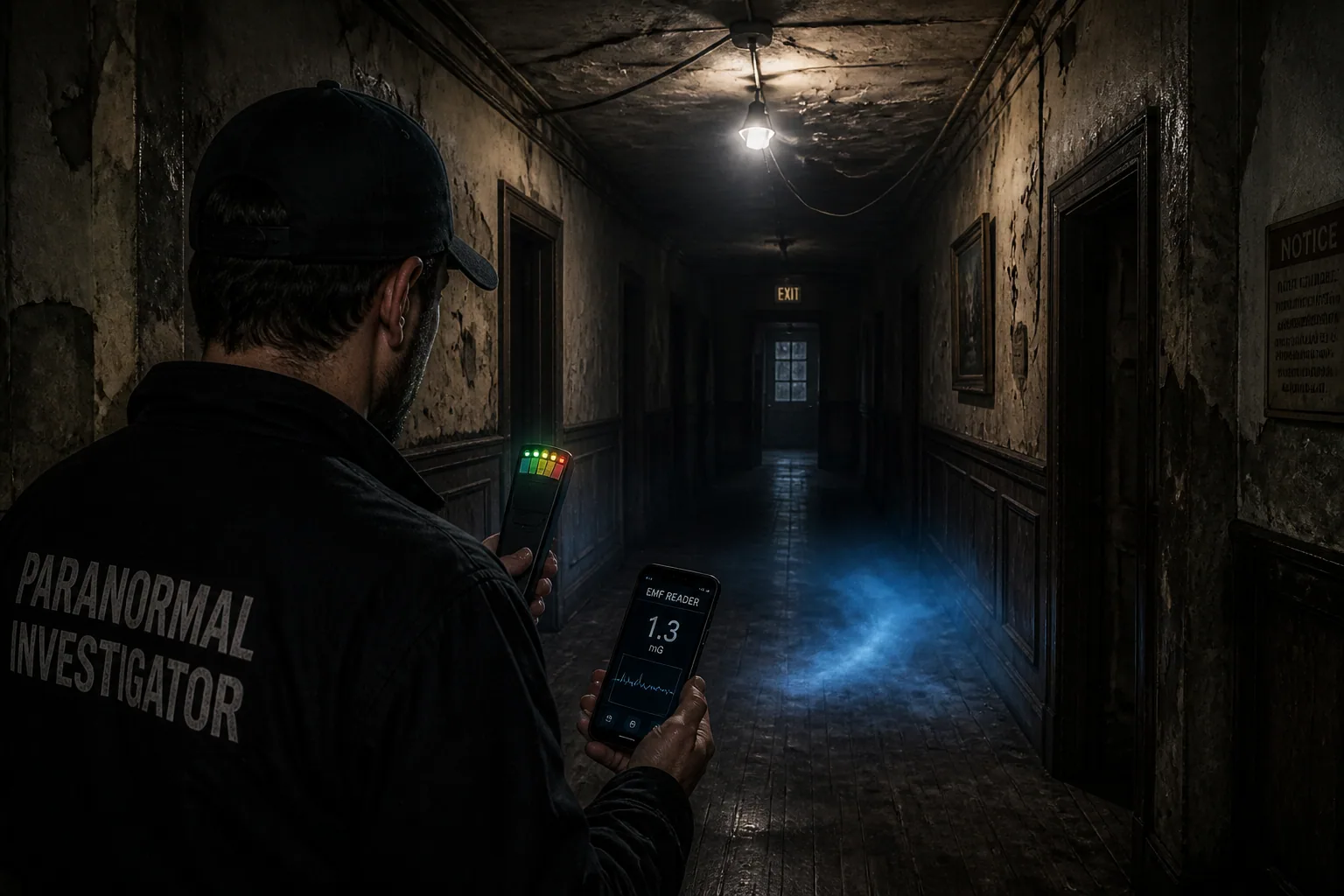
Why Haunted Places Feel Creepy: The Science Behind EMF Spikes, Cold Spots, and Sudden Sensor Anomalies
Haunted places can feel unnerving long before anyone claims to see a shadow or hear a whisper. Often, the first thing people notice is not a ghostly figure, but a strange shift in the air, a flicker of light, a weird reading on an EMF meter, or a sudden cold patch in one corner of the room. Those moments feel meaningful because they arrive all at once, in a setting already loaded with expectation.
What makes paranormal hotspots so compelling is that many of the classic signs associated with hauntings do happen for real. The difference is that they often come from ordinary causes such as wiring, drafts, pressure changes, sensory priming, or the way our brains interpret uncertainty. Understanding that does not make the mystery less interesting. It actually makes investigations sharper, because you can tell the difference between a genuine environmental anomaly and a spooky false alarm.
Why Haunted Spaces Trigger Real Physical Reactions
A supposedly haunted location is often an environment full of subtle stressors. Old architecture can create strange airflow, dim lighting reduces visual certainty, and unfamiliar sounds or vibrations make your body stay on alert. When a place already looks abandoned, worn, or historically charged, your nervous system begins to treat it as significant before you even start measuring anything.
This is part of why haunted experiences feel so convincing. Research on environmental psychology suggests that many paranormal reports emerge from overlapping sensory factors, including poor lighting, temperature anomalies, infrasound, electromagnetic changes, and the expectations people bring into the space. A review on haunted houses describes these stimuli as interacting with belief to shape what visitors feel and report, even when the environment itself is completely ordinary in a technical sense. Source: https://pmc.ncbi.nlm.nih.gov/articles/PMC7304295/
That does not mean the sensations are fake. They are real experiences, just not always supernatural ones. A chill, a sense of being watched, or a sudden burst of unease can arise from physical cues your brain is processing below conscious awareness. In haunted settings, that creates the perfect recipe for a powerful impression.
What EMF Readings Actually Measure
EMF meters are one of the most common tools in paranormal investigation, but they are also one of the most misunderstood. In most hobbyist use, EMF meters detect alternating electromagnetic fields created by mains wiring, appliances, and nearby electronics. They do not detect spirits. They detect changes in the electromagnetic environment.
Many handheld paranormal EMF meters are single-axis devices, which means their readings depend on the direction they are pointed. That matters a lot. If you rotate the meter, move closer to a wall, or stand near a cable run, the reading can change even if nothing in the room is actively behaving strangely. Typical indoor background levels are often around 0 to 1.5 milliGauss, though that can vary depending on the building and what is running nearby.
A 2023 study at a non-haunted control site found that EMF readings changed significantly across days and times even in a normal building, showing complex time-varying magnetic fields similar to those sometimes reported in haunted locations. That is an important reminder that fluctuation alone is not proof of paranormal activity. Source: https://journalofscientificexploration.org/index.php/jse/article/view/2725
Natural Causes of EMF Spikes in Old Buildings
Old buildings are especially good at producing confusing EMF patterns. Aging wiring, hidden junctions, overloaded circuits, fluorescent lights, transformers, electrical panels, and nearby motors can all create sudden spikes. Even if the room looks abandoned, the building may still have active electrical systems feeding security equipment, emergency lighting, or neighboring infrastructure.
Because many EMF meters respond to very local conditions, a spike can appear when you move a few feet closer to a wall, a power line, or a device you did not notice. The orientation issue also means that two investigators standing in the same room may report different readings simply because they are holding the meter differently. That can make a location seem unstable or reactive when the real explanation is geometry and wiring.
Some paranormal investigators do encounter electromagnetic fluctuations at sites without obvious electrical equipment. A 2013 study reported that at a haunted site lacking electricity-generating equipment, EMF and geomagnetic fluctuations were still significantly higher and more variable inside than outside, and serial spikes correlated with reported anomalous phenomena. That finding is interesting, but it still does not automatically establish a supernatural cause. It does, however, show why serious investigators need baseline comparisons before drawing conclusions. Source: https://www.parapsychologypress.org/jparticle/jp-77-2-212-236
Cold Spots: Drafts, Insulation Failures, and Temperature Illusions
Cold spots are one of the most famous haunted-place sensations because they feel immediate and bodily. You walk through a room and suddenly feel a pocket of cold air, which seems like the exact kind of thing a spirit might cause. In reality, cold spots usually have very practical explanations.
They often appear near doorways, old windows, cracks in walls, badly insulated sections, or places where air pressure changes force movement through tiny gaps. Lower humidity can also make a cold area feel more intense and more noticeable. Infrared cameras frequently reveal that these zones line up with thermal loss, drafts, or insulation failure rather than with any paranormal source.
A good rule of thumb is that a cold spot is only interesting if you can explain what is not causing it. If there is a vent nearby, a broken window seal, a draft under the door, or an exterior wall with poor insulation, the temperature drop is likely environmental. Paranormal investigators who skip this step often mistake ordinary airflow for evidence of something unseen. Source: https://www.higgypop.com/news/cold-spots/
Why Flickering Lights and Sensor Glitches Feel Supernatural
Flickering lights, sensor anomalies, and brief camera failures can feel especially eerie because they happen at exactly the moment tension is already high. A light buzzes, a camera stutters, a motion sensor jumps, and the room instantly seems hostile. But electrical instability is common in old structures and can be caused by loose connections, overloaded circuits, incompatible devices, battery issues, RF interference, or simple low power.
The same is true for many digital ghost-hunting gadgets and phone apps. If a tool is sensitive to motion, temperature shifts, magnetometer changes, or sudden signal interruptions, it may produce dramatic-looking responses that are actually just environmental noise. In a haunted setting, people are primed to interpret that noise as meaningful.
Infrasound can add to the effect. Experimental work reported that exposure to very low-frequency sound around 18 Hz increased irritability and cortisol even when participants were unaware of the sound, and earlier work linked roughly 19 Hz infrasound to peripheral visual anomalies and the sense of being watched. In other words, a location can make people feel haunted without any ghost required. Sources: https://arstechnica.com/science/2026/04/that-spooky-sensation-likely-due-to-rumbling-pipes-not-spirits/ and https://psi-encyclopedia.spr.ac.uk/articles/infrasound/
Psychological Priming: Expectation, Fear, and Suggestion
One of the biggest drivers of paranormal interpretation is psychological priming. If you are told a place is haunted before you enter, you are already looking for evidence. Every creak becomes suspicious. Every shadow feels loaded. Every slight temperature change seems important. Your attention narrows, and your brain starts connecting dots that may not belong together.
A classic study on context-induced paranormal experiences found that participants told a building was haunted reported significantly more anomalies than those told it was under renovation, even though the environment was identical. That is a powerful demonstration of how expectation shapes perception. Source: https://pubmed.ncbi.nlm.nih.gov/9229473/
This does not mean people are inventing their experiences. It means perception is not a neutral recording device. Fear, suggestion, and group dynamics alter how details are noticed, remembered, and interpreted. Once someone in the room says they felt a presence, the rest of the group may begin scanning for confirmation, and the whole investigation can tilt toward mystery even if the site itself is mundane.
What Studies Say About Perception in Supposedly Haunted Places
The science around haunted experiences keeps pointing toward the same conclusion: atmosphere matters. Environmental triggers such as dim light, dilapidation, temperature shifts, infrasound, and EMF variation can combine with personal belief to create strong impressions of a presence. This is why haunted locations often feel different from an ordinary building even when nothing paranormal is happening.
A non-haunted control site can produce shifting EMF values across time. A haunted location can show fluctuating magnetic and geomagnetic conditions. People can also experience anxiety, peripheral visual oddities, or a sense of dread in response to low-frequency sound or sensory uncertainty. Put together, these findings explain why haunted places can feel so convincing from the inside.
The important takeaway is not that everything has a trivial explanation. It is that real-world evidence should be interpreted carefully. An anomalous sensation is a clue, not a conclusion.
Ghost-Hunter Tools vs. Scientific Measurement
Ghost-hunter tools are most useful when you treat them as measurement aids instead of truth machines. An EMF meter can tell you whether magnetic fields are changing. A thermometer can show temperature variation. A recorder can capture unexplained audio. But none of these tools can tell you, by themselves, what caused the reading.
Scientific measurement starts with comparison. You ask what the baseline is, what the room normally does, how the device behaves when moved, and whether the reading persists under controlled conditions. That approach does not kill the fun. It makes the fun more credible.
If you want a more interactive way to explore that balance, a tool like Ghost Detector: Ectify can be a fun companion for recording sessions, especially since it uses your phone’s built-in magnetometer and keeps session history in one place: https://findthe.app/ectify-fc72z0. The key is to remember that any app or meter should be treated as part of the investigation, not the conclusion.
How to Take Baseline Readings Before Calling It Paranormal
Baseline readings are the difference between a loose impression and useful evidence. Before you label anything unusual, start by measuring the area under normal conditions. Walk the room slowly, note readings at multiple points, and record where spikes occur. Then repeat the process later, ideally at a different time of day.
For EMF, check the same route with the meter held in different orientations. If the reading changes a lot when you rotate your wrist, the meter may be reacting to direction rather than to a hotspot in the room. For temperature, compare the suspicious spot to nearby surfaces and check for drafts, vents, exterior walls, doors, or windows. If possible, use more than one kind of tool so that one device is not carrying the whole story.
A simple baseline routine can save hours of confusion. First measure the area with nothing running nearby if possible. Then note what changes when lights turn on, when people enter, when doors open, or when appliances cycle. If a spike only happens under one specific condition, you may have found a trigger rather than a haunting.
Using EMF Meters and Ghost Apps Without Fooling Yourself
If you enjoy ghost hunting apps and sensors, the best approach is to stay curious and skeptical at the same time. Use the app to log readings, but do not trust any single spike as proof of the paranormal. Look for repeatable patterns. Check whether the same anomaly appears when the room is empty, when the device is oriented differently, or when you return another night.
Also be aware that many ghost apps depend on your smartphone’s sensors, which are not designed specifically for paranormal work. They can be useful for immersive sessions and for documenting what you experienced, but they are still limited by the quality of the hardware and the environment around you. That is why the strongest investigations are the ones that combine sensory observation, careful note-taking, and repeated checks.
The best investigators are not the ones who dismiss everything. They are the ones who can say, with confidence, that they ruled out the ordinary before reaching for the extraordinary.
How First-Time Investigators Can Reduce False Alarms
First-time investigators often make the same few mistakes. They enter a location already expecting activity, they skip baseline measurements, they read too much into one sensor spike, and they let group excitement drive the interpretation. The fix is not to become emotionally detached. It is to slow down.
Start with a walkthrough in daylight if possible. Identify vents, wiring, windows, loose fixtures, reflective surfaces, and any source of low-frequency noise. Then make a habit of comparing readings against the building’s ordinary behavior. If a room is cold because it faces outside and has poor insulation, that matters. If the EMF meter rises only when you stand near a breaker panel, that matters too.
When you do encounter something strange, document it carefully. Time, location, device position, weather, nearby activity, and group comments all matter. The more context you collect, the easier it becomes to separate a real anomaly from a coincidence that only feels supernatural.
The Sweet Spot Between Skepticism and the Thrill of the Unknown
The most satisfying paranormal investigations usually live in the middle ground. Total disbelief can make you miss genuinely interesting environmental patterns. Total credulity can make every draft feel like a spirit. The sweet spot is disciplined curiosity.
That mindset preserves the thrill of the unknown while keeping your evidence honest. If a place still feels eerie after you have checked the wiring, tested the airflow, measured the temperature, and accounted for suggestion, then the mystery remains. It just becomes a better mystery.
And that is really what makes haunted places so compelling. They are not eerie only because of what may or may not be there. They are eerie because your body, your expectations, and the environment all start telling the same story at once.
