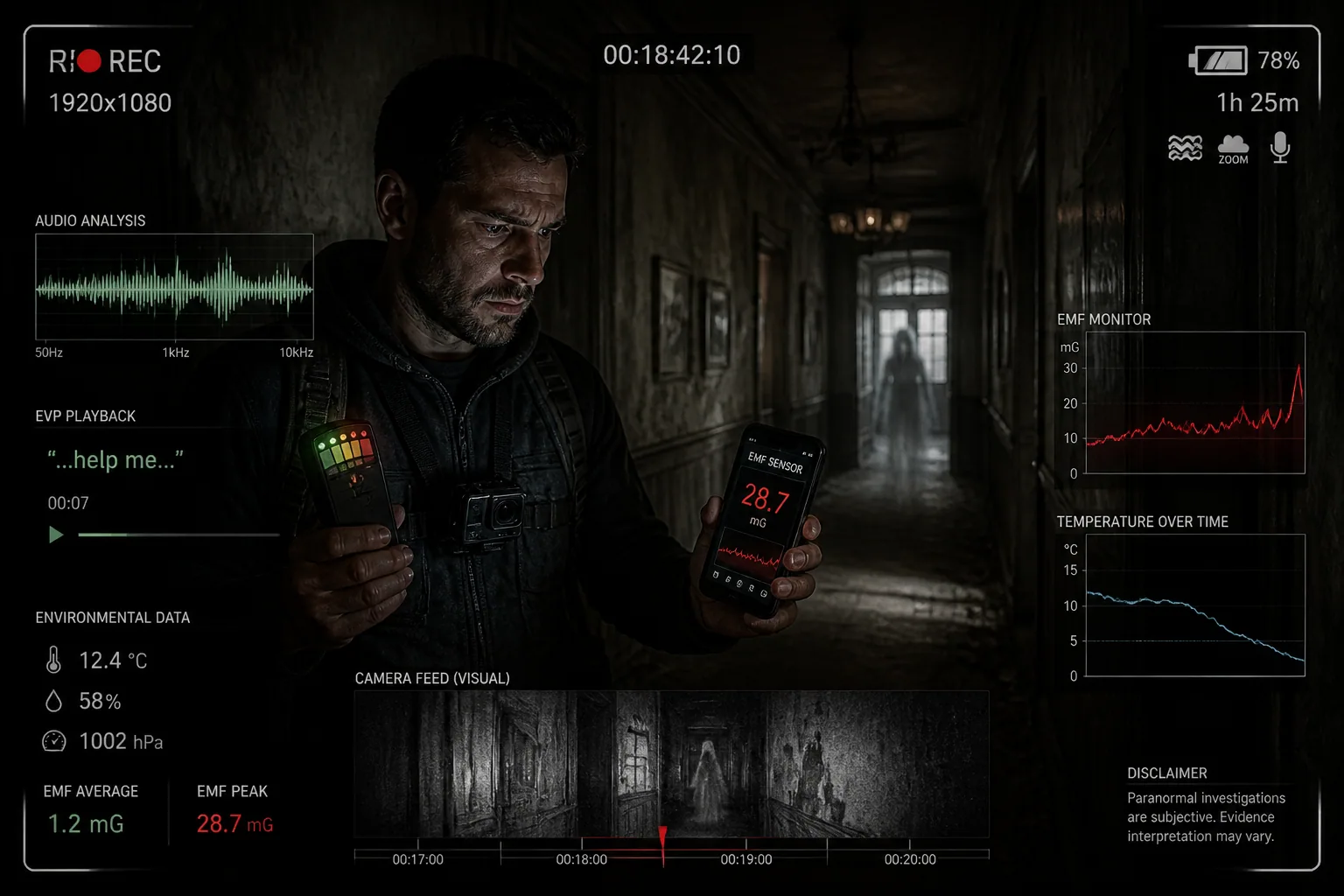
Why You Felt It but Your Gear Missed It: The Gap Between Paranormal Perception and Recorded Evidence
If you have ever walked out of an investigation saying, “I know I felt something,” and then found nothing useful in the footage, audio, or sensor logs, you are not alone. That gap is one of the most common frustrations in ghost hunting. A moment can feel intense, unsettling, or even deeply personal in real time, yet your recordings may look completely ordinary. That does not automatically mean you imagined it, and it does not automatically mean the equipment failed. In most cases, the truth sits somewhere in between.
For newer and intermediate investigators, this is one of the most important things to understand early. Paranormal work is not just about collecting data. It is about learning how people, places, tools, and expectations interact. Human perception is fast, emotional, and heavily influenced by context. Your devices, on the other hand, are limited, mechanical, and often sensitive only to very specific kinds of change. When those two systems do not line up, it can create the feeling that “something happened” without producing clean evidence.
Why Paranormal Experiences and Recorded Evidence Don’t Always Match
A live experience is not the same thing as a recorded event. In the moment, your brain is constantly filling in gaps, interpreting patterns, and reacting to atmosphere. Your body may register a chill, a pressure shift, a sense of being watched, or a sudden emotional change before you can fully explain why. By the time a camera or recorder captures the scene, that internal reaction may already be gone.
At the same time, many paranormal tools are not designed to capture everything. They measure narrow slices of reality, often with significant limitations. An EMF meter does not detect “ghosts.” A spirit box does not isolate spirit speech from radio contamination. An EVP recorder does not guarantee that every meaningful sound will be clear. Cameras miss details in low light. Apps depend on device hardware, software behavior, and user setup. So when your personal impression and your recorded evidence do not match, it is often because each one is operating under very different conditions.
That mismatch becomes even more obvious in high-stress investigations. The more alert you are, the more likely you are to notice small changes. But the more emotionally charged the environment becomes, the more likely you are to interpret those changes as significant. This is why a balanced investigation habit matters. The goal is not to dismiss what you felt. The goal is to learn how to verify it.
How Fear, Expectation, and Suggestion Shape What You Think You Felt
Fear changes perception. Expectation changes perception. Suggestion changes perception. In paranormal settings, those three influences often overlap. If you enter a location already told it is haunted, your mind starts scanning for anything that matches that idea. A strange sound becomes more meaningful. A shift in temperature feels more dramatic. A brief shadow seems like a figure.
Research on anomalistic psychology shows that belief and expectation can dramatically increase reports of paranormal phenomena even when the stimulus itself is ambiguous or neutral. In other words, what you believe is present can shape what you think you perceive. That does not mean every experience is fake. It means perception is not passive. It is active, interpretive, and vulnerable to suggestion. Source: https://en.wikipedia.org/wiki/Anomalistic_psychology
Group dynamics matter too. Interestingly, people in groups often feel less fear and perceive less danger than individuals do, even under the same threat, and this effect can increase as the group gets larger. Research discussed in a recent review notes that group presence can reduce fear responses and lower perceived danger. Source: https://pmc.ncbi.nlm.nih.gov/articles/PMC8697704/
That can work in two directions during an investigation. In a group, one person may talk themselves out of an unsettling feeling because others seem calm. Or one person may amplify a moment for everyone else, and suddenly the whole team is primed to notice the same thing. Either way, the emotional reading of an event can spread faster than the evidence itself.
The Role of Low Light, Silence, and Environment in Misreading a Moment
Paranormal investigations often take place in poor lighting, unfamiliar buildings, quiet rooms, basements, hallways, or abandoned structures. These environments are naturally disorienting. Human vision is not at its best in darkness or near-darkness. In mesopic conditions, distance, color, shape, and motion are harder to judge accurately, which makes shadows, reflections, and slight movement easier to misread. Source: https://en.wikipedia.org/wiki/Mesopic_vision
Visually impoverished settings can also create distortions or even hallucinatory effects. Darkness, lack of structure, and featureless spaces can cause people to see shapes or figures that are not really there, a phenomenon related to ideas like the Ganzfeld effect and eigengrau. Source: https://www.sciencedirect.com/topics/medicine-and-dentistry/hallucination
Silence has a similar effect. When a location is quiet, your brain starts giving extra attention to tiny cues that would normally get ignored. A creak sounds louder. A distant hum becomes suspicious. Air movement feels colder. In a place full of suggestion, even a small sensory event can trigger a big emotional response.
This is why a chilling moment may feel real and still leave no obvious mark on your recordings. The event may have been a genuine shift in your bodily state, your attention, or your interpretation of the environment rather than a measurable external anomaly. That is still worth noting, but it needs context.
Why EMF Meters, EVP Recorders, Spirit Boxes, and Cameras Miss Things
Every paranormal tool has a narrow lane. EMF meters look for changes in electromagnetic fields, but they do not tell you why the field changed. Recorders capture sound, but not all sound is equally clear or equally interpretable. Cameras record light, but only what falls within their visual range and exposure limits. Spirit boxes create a stream of fragments from radio frequencies, which means they are not clean communication devices in the scientific sense.
EMF meters are especially easy to overtrust. Many consumer ghost-hunting meters, including common K-II or K2 style devices, lack calibration detail, error margins, and numeric scales, which makes them more qualitative than quantitative. Readings can change because of orientation, nearby metal, structural wiring, and other mundane sources. Source: https://hauntedhosts.com/library/explainers/what-is-an-emf-meter-and-why-do-ghost-hunters-use-them/
Spirit boxes are also highly vulnerable to contamination. Because they continuously sweep through AM and FM frequencies, they can pick up fragments of broadcasts, radio bleed, and interference. Claims that the result is a direct reply often depend heavily on pareidolia and what the listener already expects to hear. Source: https://www.skeptic.org.uk/2024/08/the-estes-method-is-an-update-to-the-ghost-hunters-spirit-box-with-all-the-same-flaws/
EVP recordings can be equally tricky. Automatic Gain Control, or AGC, may amplify background noise during quiet moments and suppress louder sounds, which can change the way an audio event seems to behave. That can make a faint sound feel more dramatic in playback than it was in the room, or it can bury a subtle sound entirely. Source: https://www.assap.ac.uk/articles/detail/analysing-evp-and-paranormal-sound-recordings
Cameras have their own blind spots. Low light reduces detail, motion blur hides quick movement, and compression can smear edges or create artifacts. A person may feel that they saw something move in the corner of a room, while the camera only captures darkness and grain. That is not unusual. It simply means the recording system was not built to match the richness of real-time human perception.
Common Tech Problems: Range, Noise, Latency, and Calibration Drift
A lot of disappointing evidence comes down to basic technical limitations rather than paranormal absence. Range is a major issue. A sensor only measures what it can physically detect, and if the event happens outside that range, it will not appear. Noise is another issue. Sensors and microphones collect environmental clutter all the time, and that clutter can overwhelm small changes.
Latency matters too. Some apps and devices do not respond instantly. There may be a delay between an event and its display on screen, or between an environmental change and the recorded timestamp. If you are trying to compare your emotional reaction to the exact sensor spike, even a small delay can make the match look weaker than it actually is.
Calibration drift is another problem that is often overlooked. A device that seemed sensitive on one night may behave differently later because of battery condition, temperature, firmware behavior, sensor orientation, or wear. If you do not test and compare your tools regularly, you may end up treating unstable data as if it were meaningful change.
User error is part of this too. A meter held too close to wiring, a recorder placed near fabric noise, a phone app running with background interference, or a camera set with poor exposure can all produce misleading results. The device may be working exactly as designed, but the setup still makes the evidence unreliable.
When ‘No Evidence’ Doesn’t Mean ‘Nothing Happened’
It is tempting to treat absence of evidence as proof that nothing occurred. But that is not a strong investigation habit. Sometimes the moment was personal and real, yet simply not measurable with the tools you used. Sometimes the environment changed in a way that your setup did not capture. Sometimes your perception was affected by fear, expectation, or low-light confusion, but the experience still mattered because it shaped the rest of the session.
A better response is to hold two ideas at once. First, your experience deserves to be documented. Second, your experience is not automatically evidence. That distinction protects you from false certainty. It also helps you avoid the opposite mistake, which is dismissing everything because the recordings are incomplete.
This is where credibility begins. Good investigators do not need every moment to become proof. They need a process that distinguishes impressions from findings. If a session produces only a strong feeling and no supporting data, that is still useful information. It tells you where the reaction happened, under what conditions, and what else was going on around you.
How to Log Subjective Experiences With Accurate Timestamps
One of the simplest ways to improve your investigations is to stop relying on memory alone. The more dramatic the experience, the less reliable memory becomes after the fact. Instead, note it as soon as possible with a time reference. Even a rough timestamp is better than none.
A good log should include the exact moment, your location, what you sensed, and what was happening around you. For example: 10:14 PM, upstairs hallway, sudden cold feeling, heard a soft tap, flashlight dimmed slightly, two team members were speaking nearby. That kind of note turns a vague impression into a usable data point.
It also helps to mark emotional reactions separately from environmental observations. Write down if you felt anxious, startled, nauseous, watched, pressured, or calm. Those responses are part of the investigation record, but they should be labeled as subjective. This makes it easier to compare them later with the objective logs from your devices.
If you use a session app, a dedicated notebook, or a phone note system, stay consistent. The point is not fancy format. The point is repeatability. Over time, consistent timestamping gives you patterns that memory alone cannot provide.
Matching Emotional Peaks to Sensor Readings and Environmental Changes
The strongest investigations are usually not built on a single dramatic moment. They are built on pattern comparison. When you feel a sudden shift, the question should not only be “Was it paranormal?” It should also be “What else changed right then?”
Look for environmental shifts first. Did the temperature change? Did someone move? Did a door open? Did a vehicle pass outside? Did a device pick up a new source of interference? Did a conversation create a suggestion effect that changed the room’s mood? If you can match emotional peaks with these kinds of changes, you start separating sensation from signal.
Then compare your note with the device timeline. Did the EMF meter spike at the same moment? Did the recorder capture a sound that you missed live? Did the camera show a shadow only because someone crossed the hall? Sometimes the overlap is interesting. Sometimes it is not. Either way, the comparison is what builds case quality.
This is also where self-awareness matters. If you notice that your strongest reactions happen when you are tired, in the dark, or after hearing local folklore, that pattern is valuable. It does not invalidate you. It improves your interpretation. The more you know about your own response style, the easier it becomes to assess what is likely environmental and what is likely perceptual.
Reviewing Audio, Video, and App Data Without Confirmation Bias
Once the session is over, review your data carefully and slowly. Confirmation bias can turn a random noise into a “clear voice” and a harmless light change into a “moving figure.” To reduce that risk, try reviewing without first telling yourself what you hope to find. If possible, let another team member look at the data before you share your impressions.
When reviewing audio, listen for the whole context, not just the suspicious segment. Background hum, footsteps, building noise, device handling, and speech overlap can all change how a clip sounds. With video, check frame by frame but also watch the larger movement pattern. A single frame can be misleading if it is pulled out of context.
With app data, remember that visual graphs can look more meaningful than they are. A spike, a dip, or a sudden color change may be real, but it may also be a sensor artifact, a software delay, or a known environmental interference. Treat app output as a clue, not a verdict.
A practical habit is to create three categories after each session: subjective impressions, objective sensor events, and explained events. Not every moment will fit neatly into one category, but the structure helps you resist the urge to overstate weak evidence.
How Better Documentation Builds Credibility for Investigators
Credibility in paranormal investigation is not built by claiming certainty. It is built by showing your method. When your documentation is detailed, timestamped, and honest about uncertainty, other investigators can follow your reasoning. That makes your work more valuable even when the evidence is mixed or inconclusive.
A clean case file should show what you felt, what the tools measured, what changed in the environment, and what was ruled out. Over time, this helps you identify which locations are genuinely active, which moments were probably environmental, and which experiences need more testing. It also helps new investigators learn that “nothing on camera” is not the same as “nothing happened.”
Good notes also protect you from overclaiming on social media. A dramatic clip without context is easy to misunderstand. A detailed log with a clear sequence of events is much more defensible. That is the difference between entertainment and investigation.
Using Tools Like Ectify to Support, Not Replace, Good Investigation Habits
Tools can make investigations more immersive and more organized, but they should never replace careful habits. Something like Ghost Detector: Ectify can help you keep session history, record audio, track timestamps, and capture moments in a structured way. It is especially useful when you want a single workflow for documenting sessions and reviewing patterns afterward. You can explore it here: https://findthe.app/ectify-fc72z0
Used well, a tool like this supports investigation discipline. It can make it easier to compare what you felt in the moment with what was actually logged, which is exactly the kind of comparison serious investigators need. But the app should be treated as part of your process, not the final authority. Hardware and software can help you observe more consistently, but they cannot interpret the results for you.
That is why the best setup is still a combination of observation, documentation, and skepticism. A phone app can help you capture the session. Your notes can preserve the human side of the experience. Your review process can keep you honest about what was seen, heard, or merely felt.
A Balanced Approach: Trust the Experience, Verify the Evidence
The healthiest paranormal mindset is not blind belief and it is not dismissive skepticism. It is disciplined openness. Trust that your experience happened as an experience. If you felt fear, pressure, awe, or unease, that reaction is real as a human response. But verify whether the cause was environmental, psychological, technical, or something you still cannot explain.
That balance keeps you from two common mistakes. The first is false confidence, where every feeling becomes proof. The second is false dismissal, where anything not captured on gear is treated as meaningless. Both are poor habits. Good investigation lives in the middle, where subjective experience is respected and objective evidence is tested carefully.
So the next time you feel a sudden chill, emotional shift, or instinctive sense that something changed, do not panic if the camera stays quiet. Log it. Timestamp it. Check the environment. Compare the readings. Review the session with fresh eyes. In time, that process will make your cases stronger, your claims more credible, and your understanding of the paranormal much more grounded.
