Start with horror charades and Halloween trivia for a lively group, or choose monster drawing relay and a spooky word story if your friends prefer staying seated. All eight indoor games below work without alcohol, running, or total darkness, and you can run them with household supplies.
8 indoor Halloween games to choose from
Player counts and durations are hosting recommendations, not fixed requirements. The scare ratings assume playful prompts, steady lighting, and no surprise scares.
| Game | Recommended players | Estimated duration | Supplies | Seated-play option | Scare level |
|---|---|---|---|---|---|
| Horror charades | 4–12 | 10–15 minutes | Prompt slips, timer | Yes, use upper-body acting | Low |
| Forbidden-word descriptions | 4–12 | 10–15 minutes | Six cards below, timer | Yes | Low |
| Wink murder | 4–12 | 5–10 minutes | Folded role slips, timer | Yes, sit in a circle | Mild tension |
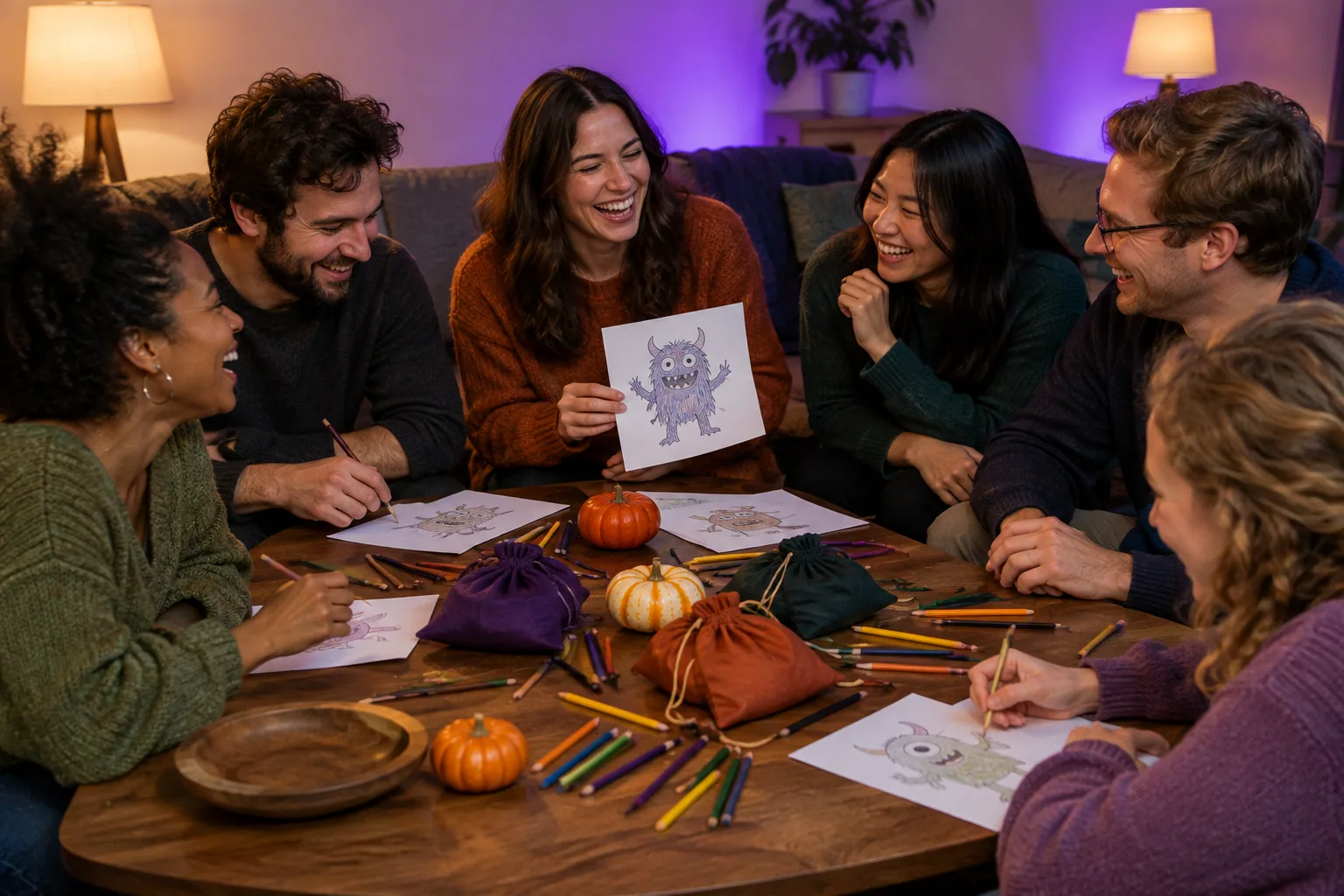
| Monster drawing relay | 4–12 | 10–15 minutes | Paper, pencils, timer | Yes | Low |
| Mystery-object bags | 4–12 | 10–15 minutes | Six opaque bags, objects, answer sheets | Yes | Low |
| Halloween trivia | 4–12 | 10–15 minutes | Questions below, paper, pencils | Yes | Low |
| Shadow guessing | 4–10 | 10–15 minutes | Cool LED lamp, clear wall, objects | Yes, host handles objects | Mildly eerie |
| Spooky word story | 4–12 | 10–15 minutes | Word slips, optional phone | Yes | Adjustable |
For a simple evening, choose one performance game, one table game, and one quieter activity. Keep a fourth ready in case your group finishes early.
Three games that need almost no supplies
1. Horror charades: act out one prompt in 60 seconds
Setup: Split into two teams. Copy the prompts below onto slips, fold them, and put them in a bowl. Set a 60-second timer and clear a small acting space, or let everyone act from their seats.
- One player draws a slip and acts without speaking, mouthing words, or pointing at the written prompt.
- Their teammates guess until they solve it or time expires. Allow one skipped prompt per turn.
- Award one point for a correct answer. Alternate teams and rotate actors.
- Finish after equal turns. The higher score wins; if tied, each team gets one extra turn, then shares the win if still tied.
For 4–6 players, use two small teams and give everyone at least one acting turn. For 8–12 players, keep two teams but rotate the actor every turn so confident performers do not take over. Cap play at 15 minutes, finishing the current pair of turns.
Use these 12 prompts:
- A vampire at the dentist
- A zombie trying to unlock a phone
- A ghost stuck in a revolving door
- A werewolf brushing its fur
- A witch whose broom will not start
- A mummy getting dressed for work
- A skeleton learning to dance
- A haunted doll waking up
- An invisible person ordering coffee
- A monster hiding under a tiny bed
- A ghost hunter startled by their own ringtone
- A vampire discovering garlic bread
If acting feels uncomfortable, let a player become the timer keeper, choose a teammate to act, or switch their turn to spoken clues. Keep upper-body prompts available for seated players.
2. Forbidden-word descriptions: explain “vampire” without saying “blood”
Setup: Use two teams, the six cards below, and a 45-second timer. Each card has a target answer and three words the clue-giver cannot say.
| Target answer | Forbidden words |
|---|---|
| Vampire | Blood, fangs, Dracula |
| Ghost | Spirit, haunted, boo |
| Werewolf | Wolf, moon, howl |
| Witch | Broom, spell, cauldron |
| Mummy | Bandages, Egypt, wrapped |
| Skeleton | Bones, skull, ribs |
- A clue-giver reads a card privately. One opponent checks the forbidden words.
- The clue-giver describes the target without gestures, spelling, rhymes, translations, or variations of the forbidden words.
- Their team has 45 seconds to guess. A correct answer earns one point; saying a forbidden word ends the turn with no point.
- Alternate teams until all six cards are used. Highest score wins; a tie is a shared win.
For 4–6 players, play in two teams and rotate clue-givers. For 8–12, assign three cards to each team and use a different clue-giver each turn. Prepare another six cards if you want a longer game, keeping the same three-forbidden-word format.
A useful clue for “vampire” is: “This character sleeps in a coffin and avoids daylight.” If someone accidentally sees a card, replace it rather than asking them to pretend they do not know.
3. Wink murder: solve a seated mystery without touching
Setup: Seat everyone in a circle where faces are visible. Make one folded slip marked “killer” and enough “detective” slips for everyone else, then have each player secretly draw one.
Agree on the signal before starting: a discreet wink aimed at one person. Anyone uncomfortable with eye contact can use an agreed hand signal instead, such as briefly raising two fingers toward the intended recipient while keeping their hand visible.
- Start a three-minute round. Players look around naturally; the killer tries to signal to one person at a time without being noticed.
- A recipient waits about three seconds, says “I’m out,” and remains quietly seated. No touching or dramatic falling is involved.
- An active detective may name one suspect. The suspect reveals their role: a correct accusation ends the round, while a wrong accusation puts the accuser out.
- Eliminated players cannot accuse or give hints. At the timer, the killer reveals their role.
With 4–6 players, the killer wins by eliminating two detectives before being identified. With 8–12, the target is three detectives. If time expires before that target, the detectives win; reshuffle roles for another round.
Keep all signals visible to the room. Secret text messages make the game harder to follow and exclude anyone not using a phone. If visual signals are inaccessible, replace this activity with the spoken story game below.
Three table games with simple household supplies
4. Monster drawing relay: pass the paper, hide the monster
Setup: Give each player one sheet of paper and a pencil. Fold each sheet into three horizontal panels, then unfold it; the panels are for the head, torso, and legs.
- Head, 45 seconds: Draw a monster’s head in the top panel. Extend two neck lines slightly into the middle panel, then fold the head backward so it is hidden.
- Pass the paper one seat clockwise.
- Torso, 45 seconds: Draw a body in the middle panel using only the neck lines as a guide. Extend two connection lines into the bottom panel, hide the torso, and pass again.
- Legs, 45 seconds: Finish the monster in the bottom panel. Unfold every sheet for the reveal.
- Number the monsters and give each player one written vote in each category: funniest, creepiest, and most unexpected.
Each vote earns the drawing one point. The highest total wins; ties share the award, and all contributors to that sheet get credit. Nobody may vote for a sheet they worked on, so with four players, simply use a noncompetitive reveal instead.
Run a second round if time allows. To reduce drawing pressure, say: “Stick figures count, and strange combinations are the point.” A guest who prefers describing can dictate to a willing drawing partner.
5. Mystery-object bags: identify six clean household objects
Setup: Put one object in each of six opaque bags and number the bags. Use clean, intact objects large enough to handle comfortably, and tell guests exactly what types of materials they may touch.
Use these six options:
- A clean cotton sock
- A wooden clothespin with smooth edges
- A plastic measuring spoon
- A soft yarn pom-pom
- A smooth plastic toy block
- An empty cardboard tube
Avoid sharp items, breakable objects, food, powders, slime, or anything wet. Check for rough edges and ask about material sensitivities before play; the mystery should be the object’s identity, not an unpleasant surprise.
- Give everyone paper numbered 1–6 and a pencil.
- Pass each bag around, allowing about 15 seconds of touch per player without looking inside. No blindfold is needed.
- Players write a guess without announcing it. Keep bags in numbered order to prevent answer-sheet mix-ups.
- Reveal the objects and award one point per correct identification. Accept ordinary equivalents, such as “clothes peg” for clothespin.
Highest score wins; tied players share the win. For 8–12 guests, use pairs and circulate the bags so several pairs can examine different bags at once.
Anyone who does not want to reach inside can feel through the bag or receive a spoken description, such as “lightweight cardboard, hollow, cylindrical.” Make that option available without asking for an explanation.
6. Halloween trivia: 12 questions without a movie marathon prerequisite
Setup: Make pairs or teams of three. Give each team one answer sheet and a pencil; ask guests to keep phones away during questions.
Read each question twice, allow about 30 seconds to answer, then move on without revealing the solution. Award one point per correct answer, accepting clear spelling variations. Use the separate key after all 12 questions.
Questions to read aloud
- On what date is Halloween celebrated?
- What carved Halloween decoration traditionally holds a light inside a pumpkin?
- What phrase do trick-or-treaters usually say at a door?
- What flying mammal commonly appears in Halloween decorations?
- What household cleaning tool is traditionally associated with a flying witch?
- What creature is said in folklore to transform under a full moon?
- What mythical creature is traditionally repelled by garlic?
- What creature is commonly pictured wrapped in strips of cloth?
- How many legs does a spider have?
- Who wrote Frankenstein: Mary Shelley, Jane Austen, or Agatha Christie?
- Who wrote Dracula: Bram Stoker, Charles Dickens, or Edgar Allan Poe?
- What word means an intense fear of spiders?
Answer key
- October 31
- Jack-o’-lantern
- “Trick or treat”
- Bat
- Broom or broomstick
- Werewolf
- Vampire
- Mummy
- Eight
- Mary Shelley
- Bram Stoker
- Arachnophobia
For a tie, give tied teams 30 seconds to unscramble NRETNA L O KCAJ, ignoring spaces. The answer is “jack-o’-lantern”; every team that solves it shares the win. To make trivia less competitive, let teams choose their own spooky names and read the answers together without ranking scores.
Two spooky games for a quieter room
7. Shadow guessing: identify objects from their silhouettes
Setup: Aim a cool LED lamp at a clear wall, placing ordinary objects between the lamp and wall. Keep another room light on so guests can see chairs, bags, and walkways; secure the lamp cord away from feet.
Test six objects before guests arrive: a mug, fork, key ring, comb, toy dinosaur, and paper bat cutout. Only the host handles them, and nothing should rest against the lamp.
- Seat two teams facing the wall. Keep the objects hidden behind a screen or inside a box.
- Show one object’s shadow for 20 seconds without rotating it.
- Each team writes one guess. Reveal the object and award one point for each correct answer.
- Repeat for all six objects, then total the scores. Ties share the win.
For a second round, slowly rotate each object before teams submit their answers. If shadows are too blurry, adjust the distance between the lamp, object, and wall before starting rather than making everyone sit in deeper darkness.
For someone who cannot comfortably see the silhouettes, offer a parallel version with two spoken clues per object. Let the whole group choose that version if it makes participation easier.
8. Spooky word story: build one sentence at a time
Setup: Write these 12 words on separate slips: key, mirror, attic, whisper, clock, footprint, letter, window, photograph, staircase, suitcase, candle. Put them in a bowl and agree on a tone, such as “eerie mystery, no gore, happy ending.”
- Start with: “The apartment was ordinary until someone found a key taped beneath the table.”
- Going around the room, each person draws a word and adds one sentence containing it. Allow about 20 seconds to think, with a free pass or redraw available.
- Keep the story connected to the previous sentence. No targeting another guest’s real fears or inventing personal details about them.
- After two trips around the circle, announce the final round. The last player gives the story an ending.
This is a cooperative game: the group wins by finishing a story in which everyone has had the chance to contribute. There are no individual points or tie-breakers. With four players, take extra rounds; with 12, keep sentences short to stay within 15 minutes.
Paper slips are the default. If you want an optional atmospheric prompt source, Ectify selects words from a curated bank based on detected environmental changes, not messages from spirits. You can read about this word-bank entertainment option before deciding whether it suits your group.
Recording is optional. Ask everyone’s permission before recording audio, and get permission again before sharing any clip; if anyone declines, leave recording off. A finished story does not need to become content.
Set up a small room without making guests uncomfortable
Arrange chairs in a loose semicircle around a table, leaving a clear route to the door and bathroom. Keep coats and bags off the floor, avoid blocked exits, and leave enough space for guests to remain seated throughout.
Gather this compact kit before anyone arrives:
- Prompt slips, role slips, and story words
- Paper and pencils for every guest or team
- A timer and one score sheet
- Six numbered opaque bags and the mystery objects
- A cool LED lamp and shadow objects, if playing
- Battery-powered candles or steady decorative lights
- Optional small prizes, such as paper award certificates
Use battery-powered lighting instead of open flames. Skip flashing effects, keep background audio low during instructions, and use steady light bright enough to read cards and move safely.
Set the comfort rules out loud: “You can pass any turn, stay seated, or watch a round. We won’t use surprise touching, jump scares, or required blindfolds.” Offer silly monsters instead of threatening prompts, and agree on story limits before the quieter games begin.
For performance-based games, offer roles such as timekeeper, reader, or scorekeeper, plus a spoken alternative. For visual games, provide verbal clues or choose trivia and storytelling instead; ask privately what would help rather than making someone explain an access need to the room.
If your group enjoys the ghost-themed story and wants a fuller evening built around it, use these ghost-hunting party ideas to plan the next gathering.
A ready-to-run 90-minute party game schedule
The scoring periods below include checking answers or voting. During the final prize slot, add team points from charades and trivia, then recognize the drawing winners separately; the cooperative story earns no points.
| Time | Activity | Host’s job |
|---|---|---|
| 0:00–0:10 | Welcome and rules, 10 minutes | Explain passes, comfort limits, teams, and seated options |
| 0:10–0:25 | Horror charades, 15 minutes | Demonstrate one turn, then rotate actors |
| 0:25–0:40 | Halloween trivia, 15 minutes | Read 12 questions, check answers, handle ties |
| 0:40–0:50 | Break, 10 minutes | Offer water and reset the table |
| 0:50–1:05 | Monster drawing relay, 15 minutes | Run drawing stages, reveal monsters, collect votes |
| 1:05–1:20 | Spooky word story, 15 minutes | Confirm tone, pass the word bowl, cue an ending |
| 1:20–1:30 | Scoring and prizes, 10 minutes | Add scores and give shared or individual awards |
For a more theatrical group, replace trivia with forbidden-word descriptions and use the story slot for two short wink-murder rounds plus instructions. For a quieter group, replace charades with mystery-object bags; keep the relay and story, or substitute shadow guessing if everyone can comfortably participate.
Before guests arrive, copy the prompts, fold the slips, test any lighting, and put each game’s supplies in its own stack. If you want optional phone-generated story words, set that up beforehand too, so nobody has to download anything during the party.
