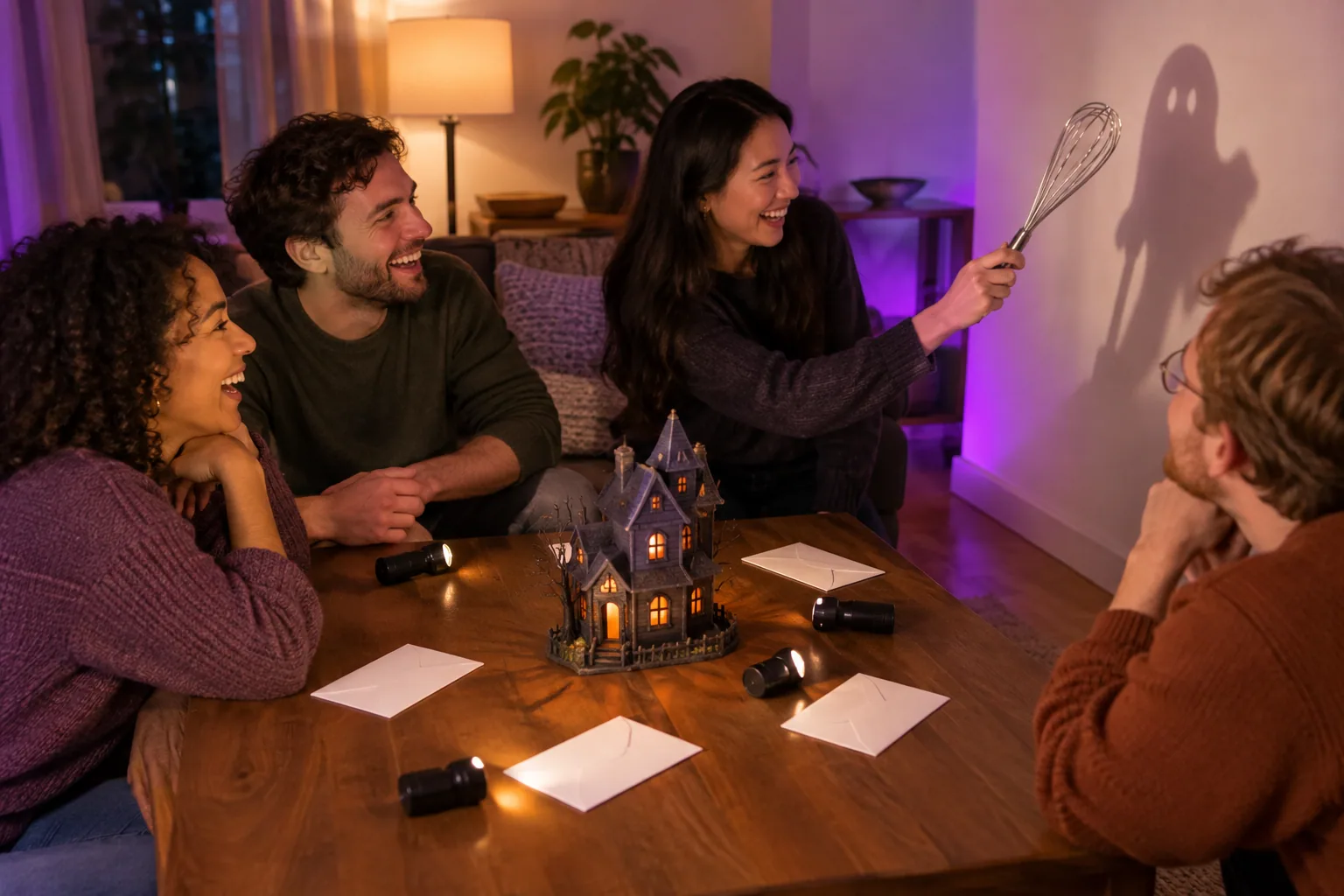
Turn your living room into a fictional investigation with a hidden-clue hunt, spooky word-story relay, mystery sounds, flashlight shadows, and a haunted-history quiz. You can run the party in 90 minutes using household supplies, teams of two to four, and an optional entertainment app. Keep the scares opt-in and treat every clue, sound, and generated word as part of a game, not evidence of ghosts.
Five ghost hunting party ideas to try with friends
Choose the clue hunt as your main activity, then add shorter games between rounds. These suggested timings include instructions and a quick answer reveal.
| Game | Supplies | Duration | Suggested group size |
|---|---|---|---|
| Fictional case-file clue hunt | Five paper clues, envelopes, pens | 20 minutes | 4–12, in teams of 2–4 |
| Spirit-box word storytelling relay | Paper word cards or an optional app | 15 minutes | 3–12 |
| Mystery-sound guessing | Six prerecorded sounds, phone, speaker, answer sheets | 15 minutes | 3–12 |
| Flashlight shadow guessing | Flashlight, blank wall, five household objects | 15 minutes | 3–12 |
| Haunted-history quiz | Printed folklore account, five questions, pens | 15 minutes | 3–12 |
1. Solve a fictional case with five hidden clues
Setup: Write “FICTIONAL PARTY CASE” at the top of the briefing. Use this premise: “The caretaker’s lantern disappeared before the annual Halloween tour. Work out who moved it, where it went, and why.”
Prepare these five clues, each in its own envelope:
- Tour schedule: “Rowan, the caretaker, was checking tickets at the entrance.”
- Volunteer note: “Maya was preparing the reading room for the children’s story hour.”
- Prop list: “One battery-powered lantern was requested for the story hour.”
- Message: “Maya: I borrowed the caretaker’s lantern. I’ll return it after the stories.”
- Room checklist: “Reading room ready. Lantern placed beside the storyteller’s chair.”
Hide the envelopes in reachable places within one clearly marked play area. Number the locations on a simple room map so guests know where searching is allowed. Use several copies of each clue if you have multiple teams, and keep a spare set at the game table.
Rules: Teams collect or read all five clues, then submit three answers: who moved the lantern, where it is, and why. Nothing requires opening drawers, moving furniture, or entering an unmarked room. If a team stalls, offer this hint: “Compare the prop list with the message.”
Finish: Stop after 20 minutes or when every team submits an answer. Reveal: Maya moved it to the reading room for the children’s story hour. Award one point per correct answer rather than rewarding whoever runs fastest.
2. Build a spooky story from generated words
Setup: Make 12 paper word cards, such as “attic,” “letter,” “clock,” “visitor,” “rain,” and “key.” Alternatively, use an optional spirit-box app for word prompts. Explain that app-generated words are entertainment prompts, not spirit messages.
Rules: Start with: “At 11 p.m., someone found an envelope on the kitchen table.” Each player draws a card or takes the next displayed word, then adds one sentence containing it. Allow about 30 seconds per turn; anyone may pass or swap a prompt they dislike.
Keep the story fictional. Don’t turn a guest’s deceased relative or personal loss into a plot point unless they specifically asked for that topic.
Finish: After two trips around the group, the final player supplies an ending. For a larger party, let each team build a separate story and share its final three sentences. Give playful awards such as “best twist” or “funniest explanation,” with no claim that the prompts revealed anything paranormal.
3. Identify six ordinary mystery sounds
Setup: Record six household sounds before guests arrive: keys jingling, paper crumpling, a zipper, a spoon tapping a mug, a drawer sliding, and water poured into a glass. Keep each clip short, check that it plays clearly, and write an answer key.
Rules: Play each clip twice at a comfortable volume. Teams write one guess before you move to the next sound. Tell them up front that every recording has an ordinary source, and avoid sudden volume jumps.
If the room is noisy, pause conversation rather than turning the speaker up. You can also move this game to the quiet audio corner.
Finish: Reveal each answer and replay its clip. Award one point for each correct source, accepting reasonable descriptions such as “cutlery against a cup” for the spoon and mug. Use one final clip as a tiebreaker if needed.
4. Guess the object behind a flashlight shadow
Setup: Place a flashlight on a stable table facing a blank wall. Gather five objects with recognizable outlines, such as a whisk, comb, toy dinosaur, slotted spoon, and clothespin. Keep enough room lighting for guests to see the floor.
Rules: The host holds one object between the flashlight and wall while keeping the object itself behind a cardboard screen. Teams get 30 seconds to write a guess. Start with the object sideways, then rotate it once as a hint.
Keep the flashlight aimed at the wall, never at someone’s eyes. Don’t use glass objects or props that require guests to climb or reach overhead.
Finish: Reveal the object after each round. Score one point per correct answer. On a second round, rotate the shadow-maker role so another guest gets to create the puzzle.
5. Quiz friends on a sourced haunted-history account
Setup: Choose one short folklore account published by a local museum, library, or historic site. Print the passage with its publisher and page title attached. Pick an account that clearly describes a legend rather than presenting a haunting as established fact.
Build five questions with answers stated in that passage:
- Which building or place is associated with the legend?
- What name or description does the account give the reported figure?
- What object, sound, or event appears in the story?
- Who is credited with reporting or passing along the account?
- Which detail does the publisher describe as uncertain or disputed?
If the passage doesn’t answer a question, replace it. Don’t invent an answer to complete the quiz. Keep an answer key with the relevant sentence highlighted.
Rules: Give teams three minutes to read the passage, then collect it and ask the questions. For a lower-pressure version, leave the passage on the table and make it an open-book challenge.
Finish: Award one point per answer and read the supporting sentence aloud. Describe the results as knowledge of a published legend, not confirmation that the legend happened.
Set up a spooky space without making it unsafe
Use your home or a venue booked with permission. For a rented space, confirm rules for decorations, sound, and recording before sending invitations; ask the venue manager about any setup restrictions.
Create three distinct areas:
- Game table: Briefings, clues, answer sheets, and spare pens.
- Quiet audio corner: Sound guessing and storytelling, away from background music.
- Well-lit break area: Water, snacks, seating, and a place to sit out without explanation.
Use battery-powered candles and modest ambient lighting, but keep walkways and exits visible. Keep props away from stairs and cables out of footpaths. Skip strobes, fog, and surprise loud noises.
Say this before the first game: “Everything tonight is a party activity. Say ‘pause’ whenever you want us to stop. You can skip any round, and nobody will touch you or block your way out.” Avoid locked rooms, surprise touching, and pressure to participate.
Choose low-volume background audio from this guide to party playlists and soundscapes, then switch it off during sound-based games. Before hosting, check these additional physical comfort, fear, and privacy precautions.
Gather supplies without buying a ghost hunting kit
Start with what you already own. Nothing in these games needs specialist investigation equipment.
| Supply | Amount to prepare | Used for |
|---|---|---|
| Flashlights | One for shadows, plus an optional spare | Shadow guessing, atmosphere |
| Paper clues and envelopes | Five clues per team | Fictional case hunt |
| Pens and answer sheets | One set per team | Clue hunt, sounds, shadows, quiz |
| Phone and small speaker | One of each | Prerecorded mystery sounds |
| Household objects | Five | Shadow guessing |
| Paper word cards | 12 | Storytelling without an app |
| Printed folklore passage | One per team | Haunted-history quiz |
| Battery-powered candles | Optional | Table decoration |
If you want app-based prompts, Ectify supplies spirit-box responses from a curated word bank. Its magnetic-field readings come from the phone’s magnetometer. Neither function establishes the presence of ghosts, so use the words as story prompts rather than treating a reading as a discovery.
Keep the same standard for other equipment: an unusual reading or ambiguous sound isn’t proof of a spirit. This critical guide to ghost-hunting methods explains why ordinary explanations and cautious interpretation matter.
Run a 90-minute ghost hunting party
Assign a host to explain and reveal games, a timekeeper to announce transitions, and an optional recording volunteer. The recording role should never prevent someone from playing.
| Time | Activity | Host action |
|---|---|---|
| 0–10 minutes | Welcome and boundaries | Explain “pause,” recording choices, and search limits; form teams |
| 10–30 minutes | Fictional clue hunt | Hand out the briefing; give hints; reveal the solution |
| 30–45 minutes | Mystery sounds | Play six clips; collect guesses; reveal sources |
| 45–60 minutes | Word storytelling | Explain prompts; run two rounds; finish each story |
| 60–70 minutes | Break | Bring lights up; offer water and snacks |
| 70–85 minutes | Shadows or folklore quiz | Run one game and reveal answers |
| 85–90 minutes | Wrap-up | Share favorite moments and confirm posting permissions |
Use teams of two to four. Within each team, rotate the reader, answer writer, and spokesperson after every game; during storytelling, everyone gets a turn. Give guests who skip a round an optional role, such as keeping score, without making that a condition of sitting out.
For 15 guests, make five teams of three and duplicate the clue packets. Have teams write answers rather than shout them, so one loud group doesn’t control the evening.
Record the fun without staging paranormal proof
Ask permission before recording, then ask separately before posting. A guest can agree to appear in a private recording without agreeing to a public TikTok or YouTube upload. If someone declines, keep them out of frame and avoid recording their voice.
The storytelling round is an easy place to capture funny reactions. Keep normal lighting on faces, record phone video separately, and have the volunteer note memorable moments so you don’t need to search the entire recording afterward.
Ectify can record session audio, retain timestamped session history, and export recordings for sharing. It does not replace your phone’s video recording. Check the audio before sharing it, including background conversations from guests who didn’t agree to be posted.
Label fictional clues and host-made sound clips clearly. Use captions such as:
- “Fictional ghost-hunt party: solving clues hidden by our host.”
- “Story relay using app-generated word prompts, not spirit messages.”
- “Mystery-sound game. Every clip was recorded from an ordinary household object.”
Avoid edits that make a prepared sound appear unexplained. If you add a sound effect, label it as an added effect rather than presenting it as something captured in the room.
Adapt the games for Halloween or a smaller group
Give Halloween games seasonal props, not new rules
Use pumpkin-colored envelopes and change the missing lantern into a missing costume prop. Add fictional clues about a canceled costume contest or a misplaced candy bowl. Keep the same five-clue structure so guests don’t need another rules explanation.
Let costume-wearing players sit, write, or speak for their teams instead of crawling or squeezing behind furniture. Put removable masks aside during instructions so everyone can hear clearly.
With three guests, rotate the game leader
Give each person one activity to prepare: sounds, shadows, or storytelling prompts. The preparer hosts that round while the other two play, then roles switch. If you include the clue hunt, its creator hosts while the other two solve it together.
Fit two games and a break into 45 minutes
Use this shorter plan when guests arrive late or want a lighter evening:
- 0–5 minutes: Boundaries, recording choices, and instructions.
- 5–25 minutes: Fictional clue hunt.
- 25–30 minutes: Break.
- 30–40 minutes: Shortened word-story relay, one turn per player plus an ending.
- 40–45 minutes: Reveal favorites and confirm what may be shared.
Keep normal lighting for guests who dislike scares
Use everyday sound puzzles, leave the lights on, and tell guests the story premise before playing. Replace eerie imagery with a missing-prop mystery while keeping the teamwork and guessing.
Before you invite anyone, choose your two must-play games, prepare their answer keys, and include this line in the invitation: “Spooky party games at my place, optional scares, no real investigation, and no recording without permission.”
