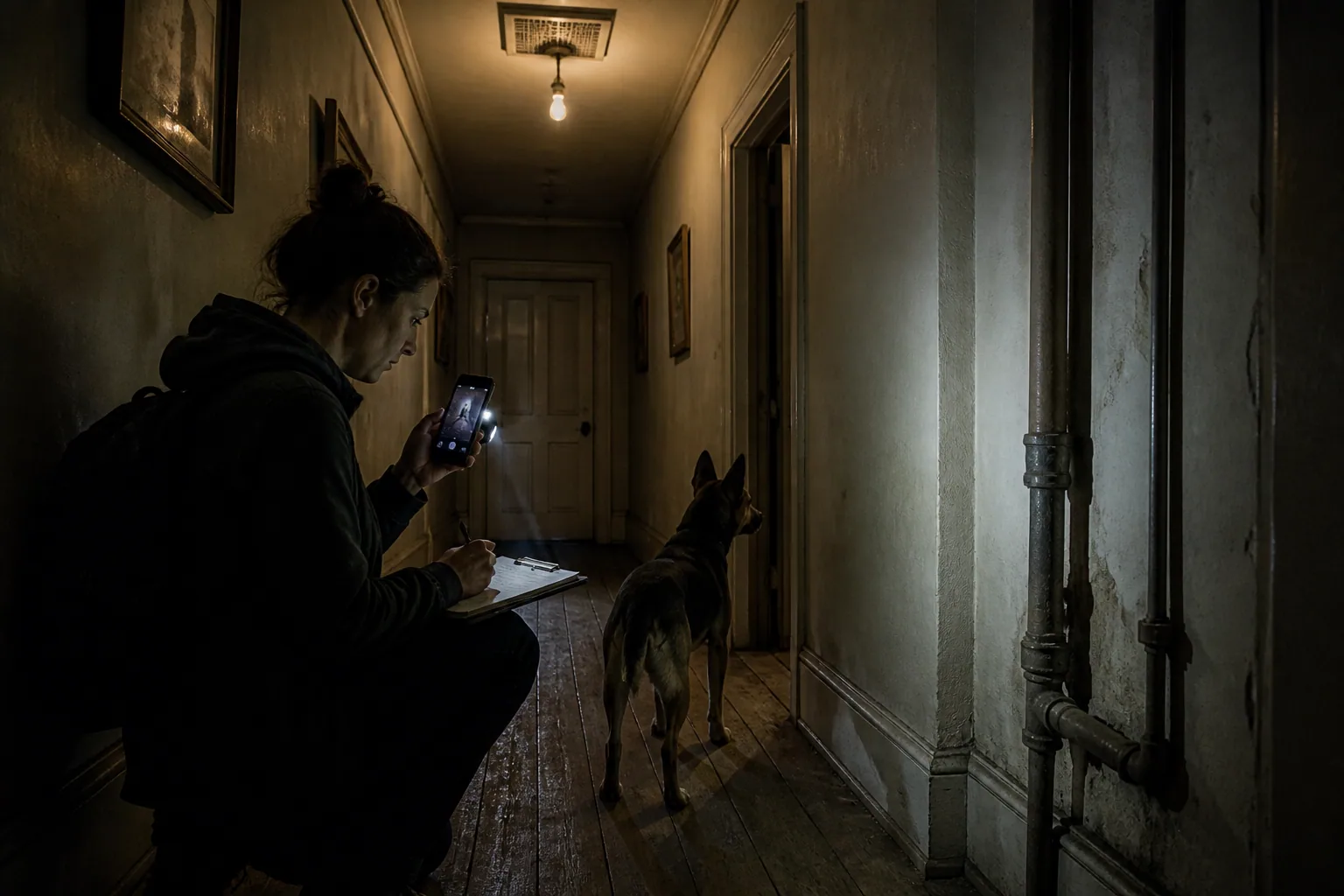
How to Use Your Home’s Odd Features as Clues: Turning Everyday Anomalies Into Better Paranormal Evidence
If you have ever walked into a room and thought, “That was weird,” you already have the right instinct for better ghost hunting. The problem is not noticing odd things. The problem is jumping too quickly from odd to paranormal. In a real investigation, a creaky stair, a flickering light, or a sudden cold draft is not proof of a haunting by itself. It is data. And data only becomes useful when you know what normal looks like first.
That is why the best investigators treat a home like a system. Houses have habits. They breathe, settle, hum, buzz, shift, and react to weather, occupancy, plumbing, wiring, and HVAC cycles. Once you learn those patterns, you can separate the background noise of a building from the genuinely unusual moments worth paying attention to.
Why Everyday House Quirks Matter in Paranormal Investigations
A lot of rookie paranormal evidence comes from surprise, not analysis. A door closes on its own, a radio crackles, a floorboard pops, and suddenly the explanation becomes a spirit. But homes are full of physical causes that mimic haunting behavior. That is why a good case starts with observation, not interpretation.
The goal is not to explain everything away. The goal is to eliminate the obvious before you call something unexplained. When you do that, the remaining anomalies carry much more weight. A weird event in a house with no baseline is just a story. A weird event that stands out against documented normal conditions is evidence worth reviewing.
A useful mindset is simple: every house has a normal version of itself. If you do not know that version, you cannot tell whether the event in front of you is truly unusual.
The Most Common Home Features Mistaken for Hauntings
Many of the things people report as paranormal are actually house behavior that has been ignored for years. Creaking floors, sticking windows, loose door latches, and pipes that knock at certain temperatures are classic examples. Older buildings are especially good at producing these effects because they settle, expand, and contract as conditions change.
Electrical issues are another common source of confusion. Flickering lights, random buzzing, power dips, radios switching to static, doorbell chimes, and electronics that misbehave can all feel eerie in the moment. But loose wiring, moisture, voltage fluctuations, component failure, and nearby electrical loads are usually better explanations than anything supernatural.
Even air movement can be deceptive. A draft through a poor window seal can make a door shift, stir curtains, or create a sudden chill that feels like a presence. When a house has hidden airflow patterns, the body often notices them before the mind does.
This is why the odd features of a home should never be dismissed. They should be mapped. The more you understand the house, the less likely you are to mistake an ordinary defect for a paranormal event.
How to Establish a Baseline for Sounds, Lights, and Airflow
Before you investigate, establish what the home normally does. Paranormal Initiative recommends baseline readings that include sound, airflow, lighting, temperature, EMF, structure noise, appliance cycles, nearby roads, weather, and occupancy before starting an investigation (https://paranormalinitiative.com/paranormal-investigation). That list matters because nearly every category can produce false leads if you only capture a single moment.
For sound, use a phone recorder or any audio device and record at least 5 minutes of ambient audio in each room. Paranormal Learning Center suggests doing this under different conditions, such as HVAC on versus off and refrigerator cycle audible versus silent, so you can define the room’s normal noise floor (https://paranormallearning.com/blog/field-investigation-protocols). In practice, this gives you a reference point when you later hear a tap, hum, pop, or whisper-like sound.
For light, note which fixtures flicker, which bulbs are old, and whether dimming happens when appliances turn on. For airflow, feel for cold spots near windows, vents, basement doors, and attic access points. A simple candle, incense stick, or even a light tissue can help reveal movement, but only if you document where and when you test it.
Baseline work is not glamorous, but it is the backbone of credible ghost hunting. If the room always creaks when the furnace kicks in, that is not an event. It is the room behaving normally.
Documenting Structural Oddities With Photos, Notes, and Floor Plans
The structure of the building itself is often the first clue. Lodestra recommends noting which floors creak, which doors do not latch well, where windows leak air, and whether the building is old enough to settle and shift with temperature (https://lodestra.com/how-to-write-better-notes-during-a-ghost-hunt-a-field-guide-to-paranormal-research/). That kind of note-taking turns a vague feeling into usable context.
Take photos of the exact areas that behave strangely. Photograph the door that sticks, the window that rattles, the hallway that gets drafty, and the stair where the second step always pops. Then add written notes with the time, room name, weather, and any nearby activity. If you can sketch a simple floor plan, even better. Mark vents, outlets, appliances, radiators, and wall boundaries so you can see how one area might affect another.
One of the most important habits is to separate observation from interpretation. Ghostology 101 and Paranormal Initiative emphasize that field notes should distinguish what was actually seen or heard from what the investigator thinks it means (https://paranormalinitiative.com/ghostology-101-lesson-14). For example, write: “At 9:22 PM, three tapping sounds were heard from the north wall.” Do not write: “a ghost tapped on the wall.”
That distinction sounds small, but it changes everything. Observation preserves the raw event. Interpretation can come later, after you have checked the building, the environment, and the equipment.
Simple Acoustic Tests You Can Do Without Extra Equipment
You do not need a specialized lab to learn a lot about a room’s sound behavior. Start with your ears, a voice recorder, and patience. Walk through the space slowly and listen for repeated sounds: pipe ticks, HVAC clicks, refrigerator hums, settling pops, and footsteps from adjacent rooms or outside.
A basic acoustic test is to record the room in silence, then repeat the recording with different conditions. Try HVAC on and off. Try it while a refrigerator cycles and again when it is silent. Paranormal Learning Center’s guidance to capture at least 5 minutes per room under different conditions is useful because it helps define the normal background sound level before you ever label something unusual (https://paranormallearning.com/blog/field-investigation-protocols).
If you hear a suspicious thump during the investigation, compare it to your baseline. Does it match the rhythm of a nearby appliance? Does it happen when someone shifts weight in another room? Does it align with a road truck passing outside? Recording the environment from multiple angles makes later review much more honest.
This process also helps with EVPs. A voice-like sound is far less convincing if you already know the room has a recurring acoustic echo, a vent that whistles, or a pipe that knocks every time hot water runs.
How Plumbing, Wiring, and HVAC Systems Create False Paranormal Signals
Many of the most dramatic haunting reports come from systems people rarely think about. Plumbing can knock, ping, and rattle. Heating and cooling can create sudden bursts of air, fan noise, temperature changes, and expansion sounds. Wiring can introduce flicker, buzzing, static, and brief power instability. These are the hidden mechanics of a house, and they often explain the exact moment someone feels spooked.
Electrical anomalies in particular can be misleading. Weird Witnessed notes that haunted house reports often include flickering lights, random buzzing, power dips, radios switching to static, doorbell chimes with no visitor, and electronics misbehaving, while natural causes commonly include loose wiring, moisture, voltage fluctuations, component failures, and nearby electrical loads (https://weirdwitnessed.com/haunted-house-electrical-anomalies-lights-radios-doorbells-and-power-problems/). That is a useful reminder that creepy does not equal paranormal.
If a radio suddenly blasts static or a sensor spikes when an appliance turns on, the next step is not to celebrate evidence. It is to ask what else was running on the circuit, what the weather was doing, and whether the house has any known wiring issues. Good investigation is more like troubleshooting than treasure hunting.
The more you understand these systems, the easier it becomes to spot a real anomaly because it will not behave like the usual mechanical noise or electrical interference you have already documented.
Reading Pet Behavior Without Overinterpreting It
Pets can be interesting witnesses, but they are not lie detectors. Dogs, cats, birds, and even small animals react to sound, scent, movement, routine changes, and stress. A dog staring at a wall may be hearing a mouse in the attic, reacting to a neighbor’s movement, or noticing a sound too faint for you to catch. A cat suddenly fixating on a doorway may be tracking airflow or a tiny reflection.
The mistake is assuming that unusual pet behavior is automatically paranormal. It is better to treat it as a prompt for more observation. What changed in the room? Was there a noise? Was the heating system cycling? Were doors open? Was someone outside? Did the pet already seem restless before the event?
When you log animal behavior, use the same observation-first approach you would use for other evidence. Note the exact time, what the pet did, how long it lasted, and what else was happening in the house. A pet may absolutely be part of an interesting case, but only if its behavior is understood in context.
Ruling Out Mundane Causes Before You Log Paranormal Evidence
This is the part that separates a compelling case from a weak one. Before logging anything as paranormal, systematically rule out common causes. Check whether windows were open, whether doors were rattling, whether the HVAC was on, whether an appliance was cycling, whether anyone else was moving around, and whether weather or traffic could have affected the room.
A good log should include date, arrival and departure times, weather, building condition, names of everyone present, whether windows or doors were open, heating or cooling status, appliances running, pets, external noises, and power sources present, which is exactly the kind of detail recommended in investigation logs by Psychical Explorers and HauntGears (https://psychicalexplorers.com/blogs/paranormal-investigation-log). The more complete the context, the easier it is to eliminate false positives later.
Think of this as evidence filtering. If a sound can be explained by a pipe, a footstep, or a passing truck, it should not be labeled paranormal. If an EMF spike matches the refrigerator cycle or a nearby outlet, it should be treated as environmental, not mysterious. Only after you remove the ordinary should you keep what remains.
Re-Listening to EVPs and Rechecking EMF Data With Fresh Context
EVPs and EMF readings are often more useful during review than during the live session. Once the adrenaline fades, you can listen more carefully and compare the moment to your baseline. HauntGears recommends documenting the recorder model, microphone type and placement, operator, room conditions, date and time, names of witnesses, and interruptions such as footsteps, talking, or traffic verbally in the recording (https://hauntgears.com/how-to-document-ghost-evidence). That makes later review much more reliable.
When you re-listen to an EVP, ask a few simple questions. Was there another person in the building? Was a fan running? Did the recording pick up a doorway echo? Was there a car passing outside? Does the phrase become clearer when played at a different speed, or does it actually sound less like speech once you listen in context? A compelling EVP is not just about what sounds spooky. It is about what survives careful review.
For EMF data, build a map of your environment first. Paranormal Learning Center advises mapping EMF sources in the home, including outlets, fuse panels, refrigerators, microwaves, Wi-Fi routers, cordless phones, and baby monitors, and photographing readings at fixed points to establish normal levels (https://paranormallearning.com/blog/field-investigation-protocols). That way, when you see a spike, you can compare it against a known source instead of guessing.
A useful investigation habit is to correlate multiple streams. Paranormal Learning Center also notes that building a timeline across audio gaps, EMF spikes, temperature drops, and witness reports strengthens a case, while single-source anomalies are weak by comparison (https://paranormallearning.com/blog/field-investigation-protocols). If the same moment appears across several data types, it is far more interesting than a lone blip on one device.
Some investigators also sort EVPs into clarity tiers, such as Class A, B, or C, based on how clearly a voice is distinguishable and how well normal explanations can be ruled out, a practice described by HauntedSilence (https://hauntedsilence.com/paranormal-101/paranormal-investigation-report-writing-guide/). Even if you do not use that exact system, the idea is sound: not all voice-like audio deserves equal confidence.
Building a More Credible Case From Ordinary Clues
The strongest paranormal cases are not built on the strangest moments alone. They are built on context. When you understand a house’s quirks, your evidence becomes sharper, because you can tell the difference between a normal creak and a truly unusual one. You stop treating every oddity as proof and start treating each one as a clue that needs a test.
That is the real value of this approach. It makes you a better investigator, even when the answer is mundane. You learn how the building behaves, how the environment changes, and how your equipment responds. And if something still cannot be explained after that process, your case is stronger because you did the work.
If you want to make that process easier during live sessions, a tool like Ghost Detector: Ectify can help you capture and revisit moments as they happen, especially since it records session history and keeps timestamps for later review. You can check it out here: https://findthe.app/ectify-fc72z0
At the end of the day, better ghost hunting is not about believing less. It is about observing better. Ordinary clues are where credible cases begin.
